

On Saturday, U.S. District Judge Mustafa T. Kasubhai issued a blistering 49-page written opinion vacating the Kennedy Declaration—the December 2025 declaration that threatened to revoke all federal funding, including Medicare and Medicaid, from any hospital or provider that offered gender-affirming care for transgender youth, a virtual death sentence for any hospital system. The vacatur applies nationwide, eliminating the legal basis that roughly 40 hospitals cited when they shuttered their trans youth care programs earlier this year. It also bars the Trump administration from implementing the Declaration or any materially similar policy threatening providers' federal funding for offering gender-affirming care. The ruling could have enormous implications in states like Colorado, where Children's Hospital Colorado is fighting a state Supreme Court case while still citing federal threats as justification for refusing to treat trans youth, and in New York, where hospitals have come under fire under state nondiscrimination law. The ruling goes into effect immediately.
The case centers on the Kennedy Declaration, issued on December 18, 2025, which was widely covered at the time as a "nuclear option" against transgender youth care. The administration's attack came on two tracks. First, CMS released two proposed federal rules barring hospitals providing trans care from Medicare and Medicaid. Because virtually every hospital in America depends on Medicare and Medicaid funding to survive, the rules would have functioned as a de facto nationwide ban. Secretary Kennedy, not content to wait for the long rule-making process, simultaneously issued the Declaration, which invoked an obscure HHS regulation allowing the department to exclude providers from federal health programs if they furnish care that "fails to meet professionally recognized standards of health care." By declaring that gender-affirming care for minors was "neither safe nor effective" and therefore failed to meet those standards, Kennedy effectively short-circuited the rulemaking process—putting a chilling policy into immediate effect without notice, without public comment, and without any of the procedural safeguards required by law. HHS General Counsel Mike Stuart then began publicly referring hospitals to the Office of Inspector General for exclusion.
The opinion was scathing, and called out the Trump administration for flagrant abuse of authority and disdain toward the rule of law. “Unserious leaders are unsafe,” Judge Kasubhai wrote in the opinion’s opening line. “There is nothing more serious than our leaders’ dedication to the rule of law so that we might maintain the integrity of our constitutional democracy. This case highlights a leader’s unserious regard for the rule of law. This case demonstrates how disregard for the rule of law does not merely result in an abstract infraction. Rather, and tragically, this case is one of a long list of examples of how a leader’s wanton disregard for the rule of law causes very real harm to very real people.”
On the government’s core argument—that the Kennedy Declaration was merely Kennedy’s personal, non-binding opinion—the judge was withering: “Defendants’ jurisdictional arguments are based on the bald-faced lie that the Kennedy Declaration amounts to nothing more than one man’s musings on gender-affirming care. This Court is not persuaded by Defendants’ attempts to gaslight it into believing that the Kennedy Declaration does anything other than what it says.” And the judge reserved his harshest words for HHS’s treatment of children’s hospitals: “Despite repeatedly emphasizing their commitment and obligation to protect children, Defendants have sweepingly wielded the Kennedy Declaration to threaten children’s hospitals that provide life-saving care to children. Citing the Kennedy Declaration, Defendants have exploited the threat of exclusion to bully healthcare providers into suspending gender-affirming care they would otherwise provide in compliance with statewide standards of care out of fear they will lose federal healthcare program funding and the attendant ability to provide any life-saving care to all children.”
Specifically, the judge found the Kennedy Declaration violated the law in four ways: it bypassed the Administrative Procedure Act's notice-and-comment requirements, bypassed Medicare's own separate notice-and-comment procedures, violated the terms of federally approved state Medicaid plans that the HHS Secretary is statutorily obligated to pay under, and—most critically—exceeded HHS's statutory authority entirely. On that final point, the judge cited a provision in the Medicare Act that could not be clearer: the statute says that nothing in the law "shall be construed to authorize any Federal officer or employee to exercise any supervision or control over the practice of medicine or the manner in which medical services are provided." The Kennedy Declaration clearly was an attempt to exercise supervision and control over the practice of medicine.
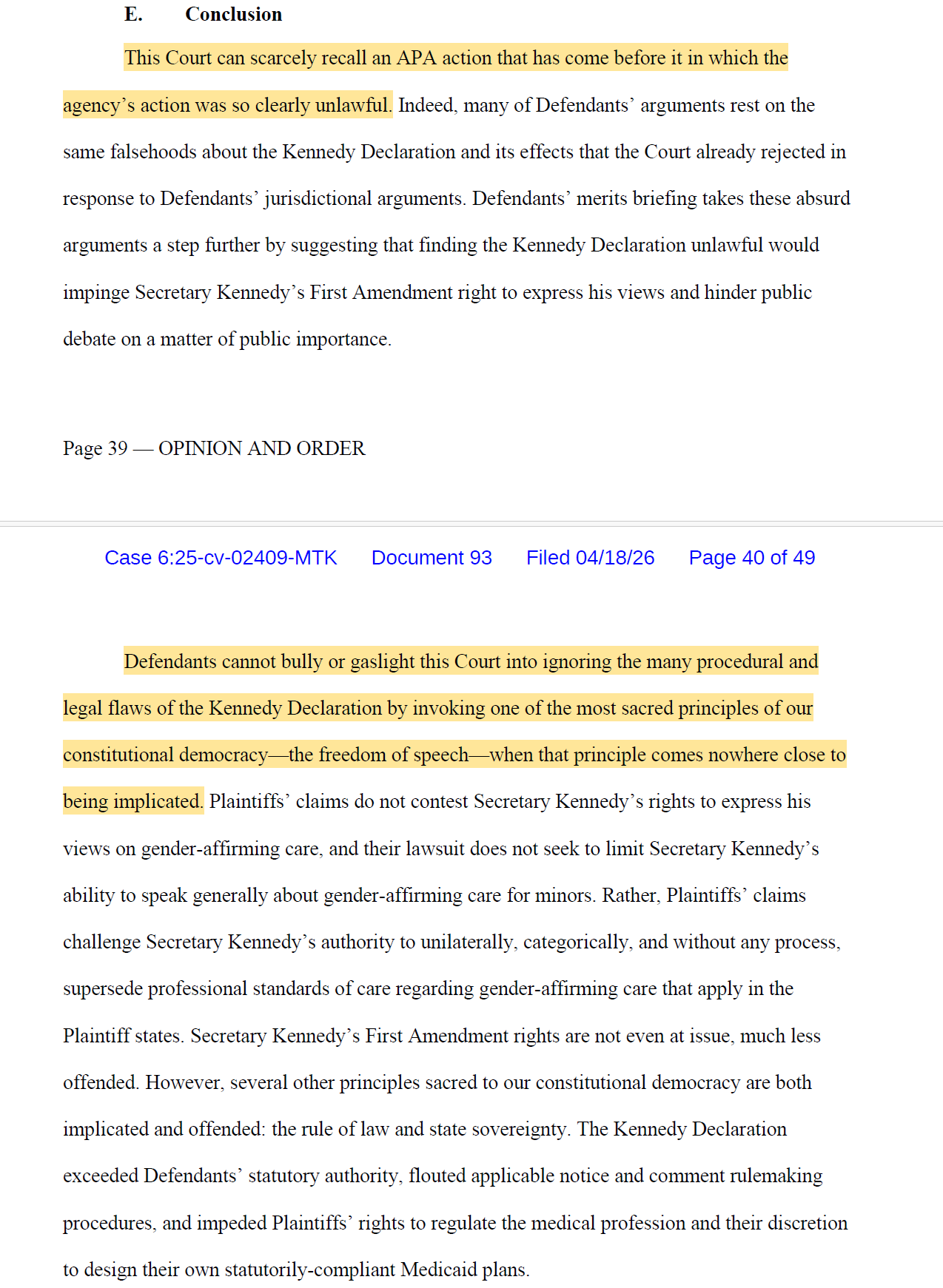
"This Court can scarcely recall an APA action that has come before it in which the agency's action was so clearly unlawful," the judge wrote. Perhaps most absurdly, the government argued that striking down the Kennedy Declaration would violate Secretary Kennedy's First Amendment rights—essentially claiming that the Declaration was not a binding federal action that threatened hospitals' very existence, but rather just one man sharing his personal opinions about medicine, and that the court should treat it as protected speech. The judge was not amused: "Defendants cannot bully or gaslight this Court into ignoring the many procedural and legal flaws of the Kennedy Declaration by invoking one of the most sacred principles of our constitutional democracy—the freedom of speech—when that principle comes nowhere close to being implicated." The court noted that the lawsuit does not challenge Kennedy's right to talk about gender-affirming care—it challenges his authority to "unilaterally, categorically, and without any process, supersede professional standards of care" while 40 hospitals shut down their programs in response.
Now that the Declaration has been vacated, hospitals have lost the primary justification they have cited for ending gender-affirming care for trans youth. The ruling does not merely block the Declaration—it permanently enjoins any “materially similar policy,” meaning the administration cannot simply rename the Declaration and try again. Hospitals that shuttered their programs by citing fear of federal retaliation—from Children’s Hospital Colorado to Children’s Minnesota to NYU Langone and Mount Sinai in New York—must now reckon with the fact that the federal threat they cited has been declared unlawful by a federal court, and the injunction bars it from being reimposed. Children’s Minnesota has already resumed care, citing the earlier oral ruling. California Attorney General Rob Bonta successfully sued Rady Children’s Hospital in San Diego, forcing it to continue care under state nondiscrimination law. The Colorado Supreme Court is weighing whether to order Children’s Hospital Colorado to do the same. This ruling strengthens every one of those efforts.
For hospitals that continue to refuse care, the legal calculus has shifted dramatically. Many of the states in this lawsuit—including New York, California, Colorado, and Illinois—have state or local nondiscrimination laws that explicitly protect transgender people. Hospitals that drop gender-affirming care in these states are arguably violating those laws, but state attorneys general, governors, mayors, and city human rights commissions have been slow to act, in part because hospitals could point to a federal declaration threatening their very existence. That excuse is now gone. It remains to be seen if elected officials now push for a return to trans youth care in alignment with those laws.
You can see the full ruling here:

May the tide continue to turn, towards love and care and liberation 🌀
"Federal Judge Vacates Kennedy Declaration"
Thank you for your reporting Erin, I so very sincerely hope this does not go before SCOTUS on appeal . . .
It is a fine enough thing for the law to be so clearly on our side as in this, but eventually we need to win on the merits of our being as equally human as cisgender people are, and not in some way lesser or diseased versions of "actually" cisgender people. The central contention and actual avenue of attack against us by Social Conservatives, is that we are "really" cisgender people who are mentally ill, demonically possessed, or obsessed with a sexual fetish -- and those ideas are what we have to destroy in law and policy, and in the common public mind.