

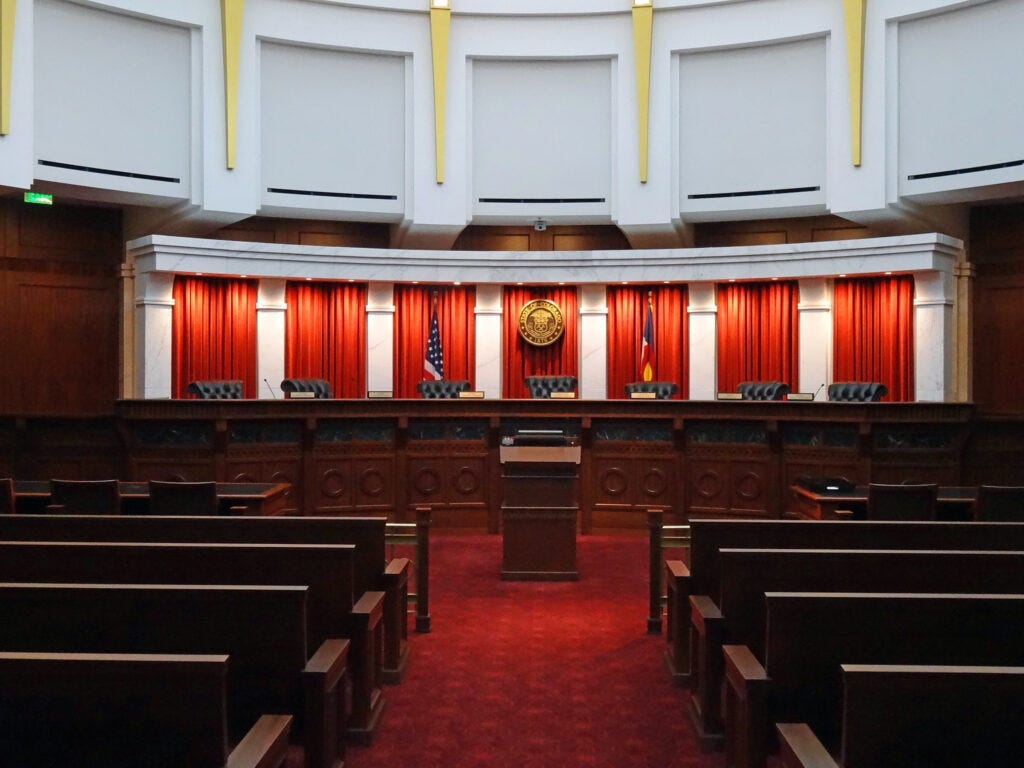
On Tuesday, the Colorado Supreme Court heard oral arguments over whether Children's Hospital Colorado can be forced to resume gender-affirming care for transgender youth. The hospital was one of roughly 40 across the country that capitulated to Trump administration threats and shuttered their trans youth care programs. However, the hospital's position has grown increasingly untenable, as hospitals in states like Minnesota and California have begun reversing course and as the Trump administration has suffered mounting losses in federal courts—including an Oregon ruling that vacated the very declaration the hospital cited as justification for halting care. Hearing arguments on Tuesday, several justices appeared skeptical of the hospital's rationale, questioning whether Colorado's civil rights protections for transgender people—among the strongest in the nation—can simply be overridden by federal threats that do not constitute law.
In December, HHS Secretary Robert F. Kennedy Jr. issued a declaration that gender-affirming care for transgender youth was "neither safe nor effective," warning that hospitals providing such care could be excluded from Medicare and Medicaid—a virtual death sentence for any hospital system. Crucially, Kennedy's declaration was illegal: Section 1801 of the Social Security Act explicitly states that "nothing in this title shall be construed to authorize any Federal officer or employee to exercise any supervision or control over the practice of medicine." Roughly 40 hospitals across the country capitulated, including Children's Hospital Colorado, which shuttered its trans youth care program in January. It is critical to note that many other hospitals continued to offer care throughout this period—and none had their Medicaid funding revoked, a fact that would prove significant in Tuesday's proceedings. In response to the closure, trans youth and their families sued Children's Hospital Colorado, arguing that no federal law compelled the hospital to stop—it was simply capitulating to Trump—and that Colorado's Anti-Discrimination Act, which prohibits discrimination based on gender identity, required the hospital to continue providing care equally to transgender and cisgender patients alike. Notably, the Kennedy Declaration was itself blocked in court in March.
The case first went to Denver District Court, where Judge Ericka F.H. Englert was sympathetic to the families on the merits—ruling that the plaintiffs would likely succeed in proving they had been discriminated against and that their children were suffering irreparable harm. Yet inexplicably, Judge Englert denied the families relief, concluding that the public interest weighed in the hospital's favor because forcing it to resume care could trigger federal retaliation. "Plaintiffs essentially ask the Court to call the bluff of the federal government," she wrote, "and order CHC to take action in violation of federal law." Scott Skinner-Thompson, a civil rights law professor at the University of Colorado Law School, told the Colorado Sun that it is "rare" to see a case where a trial court has found that plaintiffs are being discriminated against but then declined to issue an injunction to stop it. The families then appealed directly to the Colorado Supreme Court.
The hearing featured sharp exchanges over the nature of discrimination itself. Children's Hospital argued that it was not discriminating against transgender youth—and instead was discriminating on age and condition, mirroring the conservative Skrmetti ruling’s logic. "You can't infer any type of animus on the part of Children's Hospital," attorney Patrick O'Rourke told the justices. Civil rights advocates have noted that this reasoning is a thin veil for discrimination—akin to a hospital banning yarmulkes and claiming it is not discriminating against Jewish people, just enforcing a neutral dress code. Several justices appeared to see through the argument. "How is that not discrimination?" Justice Susan Blanco asked, with Justice Márquez noting that the hospital continues to prescribe the exact same medications to cisgender children. Justice Richard Gabriel agreed: "I guess I worry how that's not a pretextual argument to allow discrimination." The families' attorney, Paula Greisen, dismissed the hospital's reasoning as "semantics," arguing that all the patients—cisgender and transgender alike—"are all trying to align the timing of puberty," and that no federal law compels the hospital to discriminate. The Kennedy declaration has been blocked, she noted, and the hospital's remaining fears are "completely imaginary."
But the arguments extended beyond the question of discrimination—they went to the heart of whether state civil rights laws can survive federal intimidation. Greisen framed the case as existential for state sovereignty. “At the end of the day, if states don’t retain their sovereignty and the laws aren’t enforced, then it doesn’t matter how much our General Assembly stands up to the Trump administration or any administration and says, ‘We’re going to protect these groups,’” she told the justices. “If the court doesn’t enforce those laws, then all those laws become a house of cards.”
Several justices appeared to share that concern. Justice William W. Hood III questioned whether the hospital’s catastrophic predictions were even realistic, wondering aloud whether the “catastrophic nature of it makes it politically untenable”—suggesting the federal government would never actually follow through on shutting down a major children’s hospital. It is worth noting that no hospital that has continued to provide gender-affirming care has had its Medicaid funding revoked.
Justice Richard L. Gabriel went further, expressing alarm at the precedent the hospital’s argument would set. “I understand the position Children’s Hospital is put in here. My concern would be, pick a rogue administration down the road,” Gabriel said. “It would seem your argument is, they could take any number of absurd positions on saying whatever care could be unsafe. And that may be targeted at a particular identifiable group, and that identifiable group will always have no remedy because the government has all the cards and they control all the money. I’m concerned with that precedent.”
The justices were not universally supportive of the families' arguments, however, and some appeared to embrace caution in how they would rule. Justice Carlos A. Samour Jr. appeared the most hesitant, acknowledging sympathy for the families but expressing concern about the practical consequences. "I think we all are in favor of enforcing those laws," Samour said. "In this case, it gets really complicated, because the hospital is saying, 'Look, if we're required to provide this treatment, all these horrible, catastrophic things may very well happen.'" He asked whether there was any "middle ground" with the federal administration—such as allowing current patients to complete treatment while not accepting new ones—but the hospital's attorney said there was not. Even Gabriel, who had expressed deep concern about the precedent, acknowledged the difficulty of the court's position. "The trial court here found perfectly rationally that, 'The plaintiffs are asking me to call the federal government's bluff, and the injury if I lose on that would be dramatic,'" he said. "So how do we overturn that?"
The way the court rules could have enormous implications—not just for transgender youth in Colorado, but for how hospitals in supposedly safe states treat civil rights protections in the face of an administration that has weaponized federal funding as a cudgel against anti-discrimination laws. If the court accepts the hospital's argument that vague federal threats are sufficient to override state anti-discrimination law, the consequences extend far beyond gender-affirming care. Under that logic, any Republican administration need only issue stern threats—without passing a single law, without winning a single court case—and that alone would be enough to nullify state civil rights protections for any group it chooses to target. The laws themselves become meaningless, exactly the "house of cards" Greisen warned of. There is no timeline for when the Colorado Supreme Court will issue its ruling.
Having just relocated from Texas to Colorado, I am watching this case closely to see to what extent the state's antidiscrimination act will make a material difference in the outcome. In any event, it's amazing to be out of a fascist-run state, to a blue state with visibility.
"Colorado Supreme Court May Force Children's Hospital To Resume Trans Youth Care"
It would be awesome if they did, and it was precedent setting . . . and outside CO it won't be.
"several justices appeared skeptical of the hospital's rationale,"
There is non-existent rationality to the rationale, so. . .
Thank you for the reporting, Erin.