


Medical professionals are resisting New Zealand’s ban on new prescriptions of puberty blockers for transgender youth, violating the international best practices for treating gender dysphoria. If unchallenged, the ban will go into effect on Dec. 19 and remain in place until the United Kingdom finishes its own landmark study on puberty blockers, which according to Radio New Zealand likely won’t be complete until 2031.
On Dec. 1, 2025, the Professional Association for Transgender Health Aotearoa (PATHA) filed for an emergency injunction to overturn the provision. (Aotearoa is a pre-colonial name, derived from indigenous Māori peoples, for the land otherwise known as New Zealand.)
“These regulations are being enacted based on politics, not on clinical evidence,” PATHA president Jennifer Shields said in a press release. “We won’t let transgender children in Aotearoa be subjected to harm just to ‘win a war on woke.’ We’re taking this to court because we know what’s right, and we believe the law is on our side.”
PATHA is filing a judicial review, meaning a judge will examine the puberty blocker ban implemented by Minister of Health Hon Simeon Brown. The measure says it outlaws prescribing puberty blockers to those “with” gender dysphoria—as opposed to “for” gender dysphoria—and fines doctors who violate the order $500. Based on that language, the door could remain open to hinder these prescriptions for trans and gender nonconforming people who use these treatments for other conditions, too, such as precocious puberty and cancer.
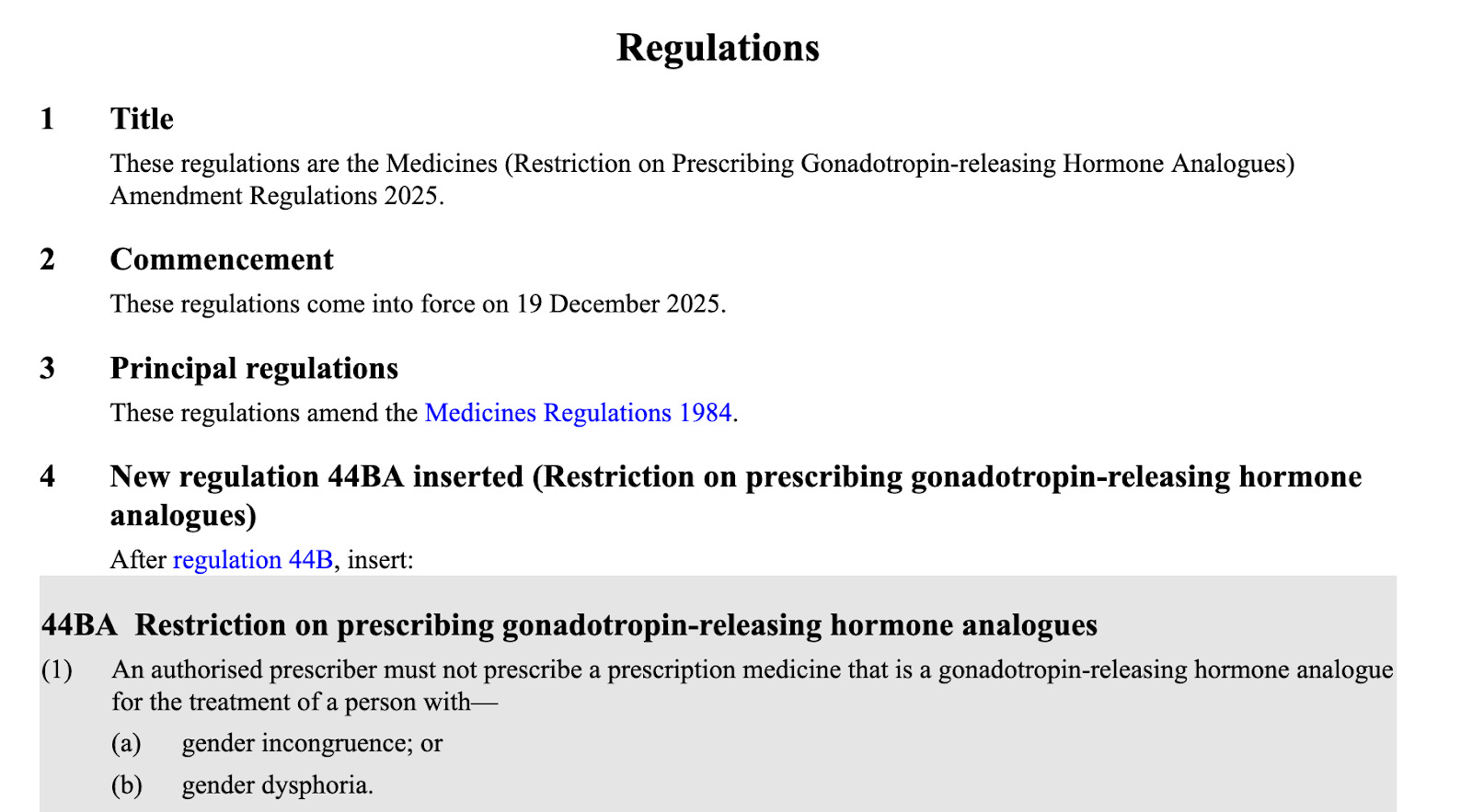
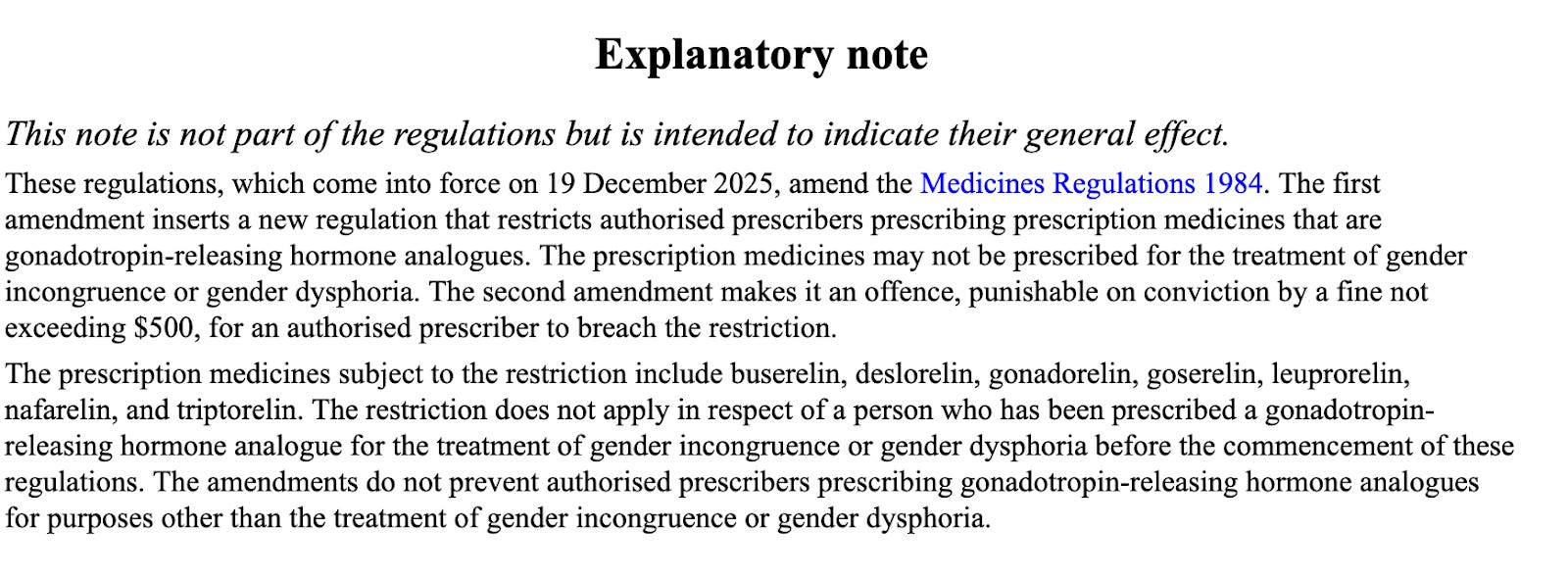
Although an explanatory note tacked on to the end of the regulation clarifies that the amendments should not inhibit prescribing puberty blockers “for purposes other than the treatment of gender incongruence or gender dysphoria,” it also states that “this note is not part of the regulations but is intended to indicate their general effect.”
Even if the court doesn’t fully litigate these grey areas, it has the ability–and perhaps the intention—of scaring some providers into overcompliance. Moreover, there is no stated age cut-off, which could foreshadow ambiguities surrounding the care of legal adults in addition to minors.
Impacted medications include buserelin, deslorelin, gonadorelin, goserelin, leuprorelin, nafarelin, and triptorelin.
The puberty blocker ban was first announced by a figurehead for New Zealand First—a right-wing populist party—on Nov. 19, on the eve of the Trans Day of Remembrance, three hours before the country’s own health minister.
“The era of woke madness is ending,” an NZ First press release declared. “This isn’t a token win. It’s a major course correction and one that marks the beginning of the end for reckless gender ideology in our public institutions.”
The Te Kāhui Tika Tangata Human Rights Commission said in a statement that the ban “represents a serious infringement on human rights.” Meanwhile, Green Party lawmaker Ricardo Menéndez March told Radio New Zealand that the government is “buying into imported culture wars”—after all, the UK study that anti-trans lawmakers are citing is a product of the National Health Service-funded “Cass Review.”
The paper is a highly politicized document meant to legitimize anti-trans rhetoric with the appearance of “scientific” backing. It called for a ban, at least temporarily, on prescribing puberty blockers for trans youth outside of clinical trials. In other words, to access life-saving care, trans youth will be forced to submit their personal health data to government researchers.
Even before the UK ban, gender-affirming care for trans minors already in the region had a years-long waitlist and a labyrinth of administrative hurdles, barriers not faced by cisgender children who need those same puberty blockers or hormone replacement therapies.
Critics of the Cass Review point to the fact it was spearheaded by a physician with zero experience treating transgender youth, and experts have condemned the report for weaponizing “methodological flaws,” “unsubstantiated claims” and an evidentiary “double standard” to undermine care, as per one article in BMC Medical Research Methodology.
But in the United Kingdom and elsewhere—including the United States—the Cass Review is being held up as sacrosanct by misguided if not malicious legal institutions, including the Supreme Court’s recent ruling against trans rights and health care in Skrmetti.
Dr. Rona Carroll, a physician and PATHA member, emphasized that puberty blockers are safe, effective, and have been used for decades—by transgender and cisgender patients alike.
“Only a small number of young people in Aotearoa are prescribed reversible pubertal suppression, but for those who need it, the negative impacts of this regulation will be huge,” Carroll said. “Politicians are ignoring the advice of health professionals, and are not acting in the best interests of children and young people who have a right to access healthcare free from discrimination.”
Erin in the Morning has reached out to the Ministry of Health for comment, but they did not immediately respond.

"But in the United Kingdom and elsewhere—including the United States—the Cass Review is being held up as sacrosanct by misguided if not malicious legal institutions"
We know it has nothing to do with being "misguided". These people in these institutions are malicious. They are guided by religion and hatred. Trans people are simply "icky" to these shysters. They don't care about trans kids injuring or unaliving themselves. Honestly, they would prefer that ALL trans people unalive ourselves so they don't have to see us or hear us.
And all such abuse of children should at least be sued into nonexistence.
The "gender critical" ideology can not make any factual case for itself. None.
All of them think the gender of a person is created after birth by upbringing. There is no evidence for this idea, but only for the opposite. The few attempts to raise a child "without gender" have all failed -- who can point out any success?
Reimer exposed the fraud of John Money, and the last tent pole holding up the idea that gender is taught fell. That was near 30 years ago. What the gendered behaviors and behavioral expectations are a retaught and learnable -- they are cultural.
That those will exist is biological, as is the impulse to seek out those around you as you grow up whom you perceive to also be of your flavor of gender, so you can emulate their gendered behaviors and successfully signal your own gender -- and for most yes with the shape of their body too.
The belief by the gender critical that transgender people are really delusionally mentally ill, or demonically possessed, or obsessed with some sexual fetish -- there is no evidence for any of this.
Point it out, make them defend their delusions and obsessions in open court.