

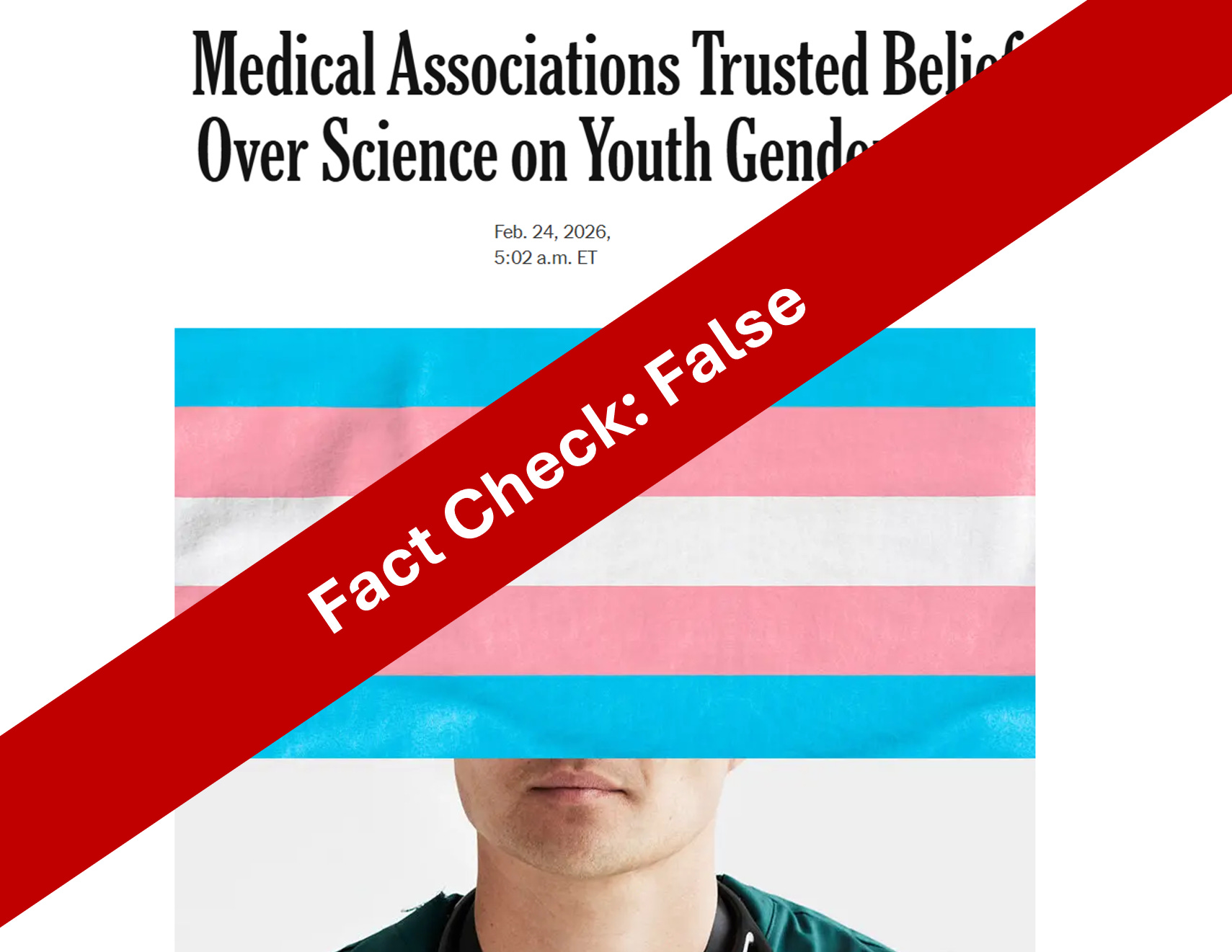
For those who have read Erin In The Morning over the years, you know that one of my most recognizable types of pieces is the fact check. Anti-trans activists, buoyed by billionaire money, routinely pump disinformation about our care into the most “reputable” outlets, publish misleading reviews to government websites, and launder misinformation with the end goal of turning the general public against transgender people. The attacks on science mirror what we see from the oil and gas industry’s assault on climate research, but tenfold—the far right has decided that transgender people are enemy number one. Now, one of the most prolific anti-trans writers working today, Jesse Singal, has taken his work to the legacy media outlet most willing to publish misinformation that harms transgender people—the New York Times. And unfortunately, it’s time for yet another fact check of this paper that routinely gets things wrong on transgender healthcare.
Singal’s latest piece, “Medical Associations Trusted Belief Over Science on Youth Gender Care,” is riddled with misleading claims, glaring omissions, and sources drawn directly from anti-trans hate groups. These are not accidental… Singal has been writing on transgender issues for years, so when he leaves something out or does not tell you the full truth in a paper like the New York Times, it cannot be recognized as anything less than what it is:direct and cynical lies deployed strategically to harm transgender people. This fact check cannot endeavor to dig into every single lie in his latest piece, but it will cover some of the big ones, showing you exactly how the anti-transgender disinformation machine works.
With no further ado, here is a fact check of Singal’s latest piece:
Claim: The American Society of Plastic Surgeons broke from scientific consensus on transgender healthcare, proving the consensus was always hollow.
Fact: The ASPS position statement was not a clinical guideline. It was issued by the ASPS board in a secretive process that bypassed the organization's own expert task force, relied on the Trump administration's widely criticized HHS report, and set an age minimum matching Trump's executive order exactly. Seven members of the task force the board circumvented wrote an open letter stating they do not even know who authored the statement.
But something confounding has happened in the last few weeks: Cracks have appeared in the supposed wall of consensus. After expressing concerns about the evidence base in 2024, on Feb. 3, the American Society of Plastic Surgeons became the first major American medical group to publicly question youth gender medicine since its widespread adoption. The organization published a nine-page “position statement” advising its members against any gender-related surgeries before age 19 and noting that “there are currently no validated methods” for determining whether youth gender dysphoria will resolve without medical treatment. (The document also acknowledged a similar level of uncertainty surrounding blockers and hormones, though that’s less directly relevant to the practice of plastic surgeons.)
Singal claims that "cracks in the wall" have appeared in the consensus around gender-affirming care, citing the American Society of Plastic Surgeons' recent position statement—a document published and immediately paraded by anti-trans activists across the country. Singal does not tell his readers how incredibly controversial and manipulated the document actually is, nor does he explain why this position statement is not a clinical practice guideline and can never be one. It cannot be held up as a case of scientific consensus breaking around transgender care, because it completely bypassed the scientific process that organizations use to issue their guidelines in favor of a politically-directed process alongside the Trump administration.
According to an open letter by members of the scientific review panel at the American Society of Plastic Surgeons, the organization convened a gender surgery task force comprised of experts in adolescent psychiatry, medicine, and research methodology in May 2025. The task force met monthly for nine months, working toward evidence-informed conclusions. But the ASPS board—led by president Bob Basu, a significant donor to both the Trump campaign and Ted Cruz, was apparently unsatisfied with the pace and direction of the experts' work. Instead of waiting for the task force's conclusions, the ASPS/PSF board secretly developed and published its own unauthored position statement, one that went through no consensus-finding process, no scientific review, and bypassed the scientific committee working on the question entirely.
Most damningly, the process appears to have been directed by the Trump administration, which has made its disdain towards transgender people entirely clear in a slew of anti-trans executive orders, some going as far as to call transgender people “dishonorable” and “false”. The statement’s age 19 cutoff matches Trump’s January 2025 executive order exactly. It relies heavily on and references the Trump administration’s HHS report on gender dysphoria, which I have previously fact-checked and found filled with pseudoscience, discredited theories, and authors connected to anti-trans hate groups. And most importantly, the process appears to have been directly initiated by Trump’s HHS department. The letter states that the ASPS statement was “initiated by a federal agency seeking clarifications of medical society positions on this topic.”
When the board released its nine-page statement on Feb. 3, it blindsided the very experts the organization had assembled to study the question. Seven task force members signed an open letter stating they were “unaware of the statement’s authors and what methodology was used.” And who celebrated? Within hours, HHS leadership issued a press release commending ASPS. RFK Jr. called it a stand against “the overmedicalization lobby.” Deputy Secretary Jim O’Neill called it “another victory for biological truth in the Trump administration.” SEGM, the anti-trans advocacy group that Singal links to elsewhere in his piece as though it were a neutral source, praised it as a “watershed moment.”
None of this is mentioned by Singal. Instead, he presents this document as a genuine break with scientific consensus—as if it were driven by new science, rather than a political process that entirely bypassed the scientific methods medical organizations use to determine their positions.
Claim: European countries are “pulling back” on gender-affirming care and are determining that gender-affirming care is not well-supported.
Fact: The largest European medical consensus on transgender youth care in history—a 400-page set of guidelines from 26 medical organizations across Germany, Austria, and Switzerland—was released in March 2025 and explicitly recommends puberty blockers and gender-affirming care. France’s first national consensus from its Society of Pediatric Endocrinology specifically recommends transgender youth care and denounces the “wait-and-see” approach. Singal’s own citation for France “pulling back” links not to any French medical authority, but to an SEGM article from 2022, an anti-trans advocacy group. New Zealand’s medical organizations are actively suing their government to preserve access to care and winning.
During this same period, a sea change occurred in Europe. Finland, Sweden and Britain conducted systematic evidence reviews of youth gender medicine — a much more transparent and regimented process designed to attenuate the influence of human bias. Every such review revealed deep uncertainty about the evidence base, and as a result the countries that conducted the reviews began more tightly regulating youth gender medicine. (Denmark has since followed suit, and there are some signs France and Norway may as well.) Which science, then, should be trusted? The confident American professional organizations or the skeptical European health care systems? What about when even the professional organizations start to schism?
Singal's framing of international treatment of transgender youth is among the most dishonest moves in his piece. He lists Finland, Sweden, Britain, and Denmark as countries that have pulled back and supported restricting care, then adds that "there are some signs France and Norway may as well." The implication is clear: the world is waking up to the dangers of gender-affirming care, and America's medical organizations are the last holdouts. This could not be further from the truth, and in fact, over the last two years, the anti-trans panic appears to be receding in European countries and internationally, with multiple international medical organizations reaffirming support for transgender youth care.
In March 2025, 26 medical and psychotherapeutic organizations across Germany, Austria, and Switzerland released over 400 pages of clinical guidelines explicitly recommending puberty blockers and gender-affirming care for transgender youth. The guidelines directly criticized the Cass Review's methodology, the very document Singal treats as gospel later in this New York Times piece, as inapplicable due to lack of expertise and transparency. In December 2024, the French Society of Pediatric Endocrinology and Diabetology released France's first national consensus on transgender youth care, recommending treatment and specifically denouncing the "wait-and-see" approach as increasing suicide risk. This is what the actual French medical establishment says. But when Singal tells New York Times readers that France may be "pulling back," his hyperlink does not go to any French medical authority. It goes to a SEGM article—the same anti-trans hate group that celebrated the ASPS statement as a "watershed moment."
And the pattern extends beyond just these countries. In New Zealand, the Professional Association for Transgender Health Aotearoa sued the government over its puberty blocker restrictions, and the High Court suspended enforcement, finding the medical organizations had "a strong case." The Royal Australian and New Zealand College of Psychiatrists have also reaffirmed the importance of transgender healthcare. Spain maintains progressive guidelines supporting trans youth care. In Canada, the Canadian Pediatric Society rejected the Cass Review's recommendations, announcing that “current evidence shows puberty blockers to be safe when used appropriately, and they remain an option to be considered within a wider view of the patient's mental and psychosocial health.” Singal's "the world is pulling back" narrative is a carefully constructed lie that requires you not to look at the countries he leaves out.
Claim: Dr. Julia Mason, Leor Sapir, and Dr. Sarah Palmer, who Singal leans on to critique the American Academy of Pediatrics, are “members” of medical organizations or independent “critics.”
Fact: Julia Mason is a co-founder and director of the Society for Evidence-Based Gender Medicine, a literal SPLC-designated hate group. Leor Sapir is a senior fellow at the Manhattan Institute, a conservative think tank whose “gender identity initiative” was funded by a $400,000 donation from the Edelman Family Foundation—Sapir is not a physician, not a scientist, but a political scientist paid to oppose trans care. Dr. Sarah Palmer has collaborated with SPLC-designated anti-LGBTQ+ hate group Genspect, which has proposed trans care bans up to the age of 25.
Policy statements like this one can reflect the complex and opaque internal politics of an organization, rather than dispassionate scientific analysis. The journalist Aaron Sibarium’s reporting strongly suggests that a small group of A.A.P. members, many of whom were themselves youth gender medicine providers, played a disproportionate role in developing these guidelines.
Dr. Julia Mason, a 30-year member of the organization, wrote in The Wall Street Journal, with the Manhattan Institute’s Leor Sapir, that the A.A.P. deferred to activist-clinicians and stonewalled the critics’ demands for a more rigorous approach. Dr. Sarah Palmer, an Indiana-based pediatrician, told me she recently left the A.A.P. after nearly 30 years because of this issue. “I’ve tried to engage and be a member and pay that huge fee every year,” she said. “They just stopped answering any questions.” This is unfortunate given that, as critics have noted, in many cases the A.A.P. document’s footnotes don’t even support the claims being made in the text.
Singal's article frames these sources as brave dissenters who simply want better evidence. Of course, anybody who pays attention to the current political fight around gender affirming care knows who these people are, something Singal does not tell his readers at the New York Times. Mason is not just "a 30-year member" of the AAP who happens to have concerns. She is a co-founder and director of SEGM, an organization the SPLC placed on its hate group list alongside groups like the Alliance Defending Freedom. The organization has gotten into trouble for pushing pseudoscience in the past, such as when it platformed Jamie Reed, an anti-trans activist who has falsely linked transition-related care to political violence and describes transgender identity as ‘a delusion’ in its continuing medical credential courses. It has since had its CME credentials pulled. This is who Jesse Singal is citing at the New York Times without context.
Singal then turns to Leor Sapir, whom Singal presents alongside Mason as a credible critic of the AAP. Sapir is not a doctor. He is not a researcher in any medical field. He is a political scientist who was hired by the Manhattan Institute—a conservative think tank—specifically to produce anti-trans content after a $400,000 donation created a "gender identity initiative." Since joining the institute, Sapir has published dozens of articles attacking trans healthcare in the Manhattan Institute's magazine City Journal, filed amicus briefs in anti-trans court cases, and co-authored the Trump administration's HHS report used to justify banning care, the very same HHS report cited by the ASPS earlier in Singal’s piece.
As for Sarah Palmer, her presence is marked by the same issues. She has worked alongside Julia Mason of SEGM and Patrick Hunter of Genspect, another anti-transgender hate group. She helped develop Resolution-27, promoted by Genspect and rejected by the American Academy of Pediatrics. Palmer attended a 2022 SEGM meeting with U.S. government officials to lobby against nondiscrimination protections in healthcare. And yet she is just portrayed as “an Indiana-based pediatrician.”
When Singal presents these people as "brave dissenters" without giving readers the full context of who they are, he is lying about where the "dissent" is coming from. As this fact check has made clear, opposition to transgender healthcare is a political project, not a scientific one. It is supported by large amounts of money, buoyed by hate groups, and put forward as something grassroots—a sleight of hand Singal attempts repeatedly throughout his entire piece, and one that must be called out for what it is.
Claim: The American Psychological Association may also be quietly retreating from supporting transgender youth care, due to a letter written to the FTC which supposedly contradicts the APA’s earlier policy statements.
Fact: The 2024 policy statement was voted on by APA's Council of Representatives and went through a full consensus process. The letter Singal cites was written by APA Services, the organization's companion lobbying arm, by Katherine McGuire, whose master's degree is in economics. The 2024 policy statement has never been rescinded or modified, and McGuire herself tells Singal in his own piece that the two documents are "consistent." In May 2025, the APA reaffirmed its support for its 2024 guidelines. And in December 2025, the American Psychiatric Association—a separate organization—approved a new position statement supporting transgender youth care and its impact on reducing suicidality. Singal does not mention either.
In 2024, the A.P.A. criticized those “mischaracterizing gender dysphoria as a manifestation of traumatic stress or neurodivergence.” In 2025, it cautioned that gender dysphoria diagnoses could be the result of “trauma-related presentations” rather than a trans identity, and noted that “co-occurring mental health or neurodevelopmental conditions (e.g., depression, anxiety, autism spectrum disorder) … may complicate or be mistaken for gender dysphoria.” It seems undeniable that the 2025 A.P.A. published what the 2024 A.P. A considered to be “misinformation.” (“The 2024 policy statement and the 2025 F.T.C. letter are consistent,” said Ms. McGuire in an email, and “both documents reflect A.P.A.’s consistent commitment to evidence-based psychological care.”)
Singal, at the end of his story, appears to portray even the American Psychological Association as retreating from transgender youth care, claiming that a letter to the FTC contradicts its earlier support for transgender healthcare. The letter itself can be found here, and though it may be a bit imprecise, it does not support what Singal says it does. For one, the APA letter was not written or determined by the APA processes for establishing policy statements, but rather, was written by Katherine Mcguire and APA Services, the organization’s lobbying arm. McGuire talks in the letter about how each case of gender dysphoria in youth is approached with “careful consideration of the unique circumstances, developmental stage, and needs of the individual child” and that care is thoughtful and individualized. These do not contradict the APA’s policy statements, and reflect exactly what we want psychologists and psychiatrists to do.
But here is what Singal leaves out entirely: In December 2025—three months after the APA Services FTC letter he treats as a bombshell—the American Psychiatric Association, a separate but equally major organization, approved a new position statement on gender-affirming care for transgender youth through its full institutional process, voted on by the Assembly in November 2025 and approved by the Board of Trustees in December 2025. It states that "data demonstrates that gender-affirming care reduces the risk of specific adverse outcomes among youth, such as depression, anxiety, and suicidal ideation," and that "families and youth should have access to the full range of gender-affirming treatment options." This is the most recent formal position from a major American psychological or psychiatric organization. Likewise, the American Psychological Association has not rescinded any of its 2024 guidelines. Neither the American Psychological Association nor the American Psychiatric Association has retreated from supporting transgender youth care. Singal mentions none of this. One wonders why.
Update: The American Psychological Association has reaffirmed its support for transgender youth care and disputes Jesse Singal’s characterization of its position in response to an inquiry from EITM.
Time and time again, the New York Times spikes the ball on transgender people. The paper has become a central source of misinformation on this issue, repeatedly publishing articles built on falsehoods about trans people, our care, and the medical guidelines that govern it. It has done so so often that the pattern has become a punchline. This latest piece is no different. That the New York Times would turn to someone as egregiously anti-trans as Jesse Singal to continue this crusade is an indictment of the paper as a whole—as if it needed any more.
May this person encounter only people with his level of integrity for the rest of his life. Double for the NYT.
Until the present administration is gone, we will continue to have these problems. Our lives are being affected by people that want to harm us. People with no medical of psychological expertise are trying to control what we can do.