

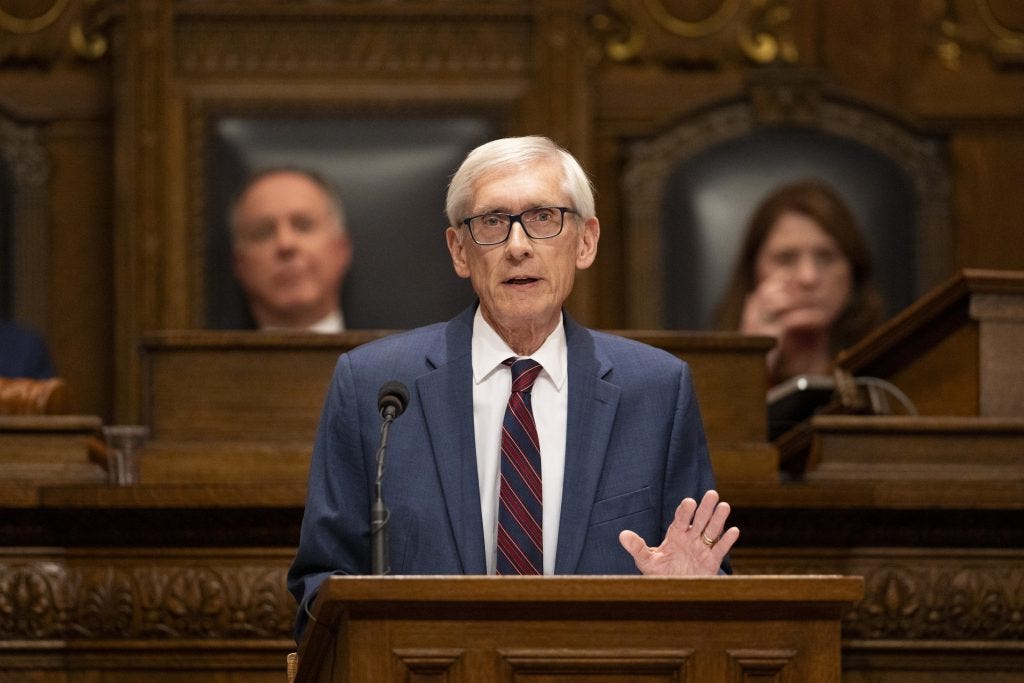
Transgender Day of Visibility was a mixed bag for many transgender people. The day opened with horrifying news from the Supreme Court, which ruled that transgender people could be legally subject to coercive conversion therapy if their parents and counselor want to practice it on them in Colorado. In Wisconsin, however, the news was more hopeful. Despite a Republican-controlled legislature—with an 18-15 majority in the state Senate and a 54-45 majority in the state Assembly—Democratic Gov. Tony Evers has on multiple occasions pledged to veto any anti-LGBTQ+ bill that crosses his desk. Now, on Trans Day of Visibility, he delivered on that promise again, issuing five vetoes against anti-trans bills in a private ceremony at the state Capitol surrounded by LGBTQ+ kids and families. "My promise has always been that I will veto any bill that makes Wisconsin a less safe, less inclusive, and less welcoming place for LGBTQ people and kids," Evers said. "It has been my honor to keep that promise over the course of two terms as governor."
Two of the bills, AB 100 and AB 102, would have instituted anti-trans sports bans—AB 100 targeting K-12 schools and AB 102 targeting the University of Wisconsin and technical college systems. Both would have classified all athletic teams by sex as determined at birth and barred transgender girls from competing on teams that match their gender identity. The bans could apply broadly to interscholastic, intramural, and club sports, covering everything from traditional athletics to activities like darts, disc golf, and even potentially chess, as has been interpreted in some locales. In his veto messages, Evers was scathing: "I object to codifying discrimination into state statute and the Wisconsin State Legislature's ongoing efforts to perpetuate hateful and discriminatory rhetoric and policies targeting LGBTQ Wisconsinites, including our transgender and gender nonconforming kids." He added: "While the federal government and other states across this country may give way to anti-LGBTQ hate, here in Wisconsin, we will continue to decline to do the same."
Another bill, AB 103, would have required school boards to adopt policies banning school staff from referring to any minor student by a name or pronouns that do not align with their "biological sex" without written authorization from a parent or guardian. The bill would have also required schools to notify all parents and legal guardians when a student requests a name or pronoun change and empowered administrators to deny the request unless every parent or guardian supports it—effectively giving any single parent veto power over a trans student's identity at school. For transgender youth in unsupportive households, the bill would have functioned as a forced outing mandate, requiring schools to disclose a student's transgender status to parents who may respond with rejection, abuse, or removal from the home. Evers vetoed the bill with a similar message, reiterating that "LGBTQ kids, including transgender and gender nonconforming kids, deserve our love, respect, and support just like any other kid."
The remaining two bills targeted doctors who provide gender-affirming care to minors. AB 104 would have banned health care providers from performing, referring for, or even “causing the engagement” in gender-affirming medical interventions for anyone under 18—and would have required the Board of Nursing, the Medical Examining Board, and the Physician Assistant Affiliated Credentialing Board to investigate any allegation of a violation and revoke the provider's license if substantiated.
SB 405 took a different approach, creating a civil cause of action allowing minors who received gender-affirming care to sue their providers for any "physical, psychological, emotional, or physiological injury" until the age of 33—a bill Democratic state Sen. Mark Spreitzer called a "blatant effort to threaten health care professionals with privileged litigation in the hopes that it will create a chilling effect." In his veto messages, Evers wrote that he objects to "restricting medical professionals like physicians from providing evidence-based and medically appropriate care to their patients, restricting parents from making decisions with physicians to ensure their kids receive the healthcare they need, and preventing patients from receiving that basic, life-saving care. Healthcare providers should be trusted to provide medically appropriate and accurate information, treatment, and care for their patients without the unnecessary political interference of politicians."
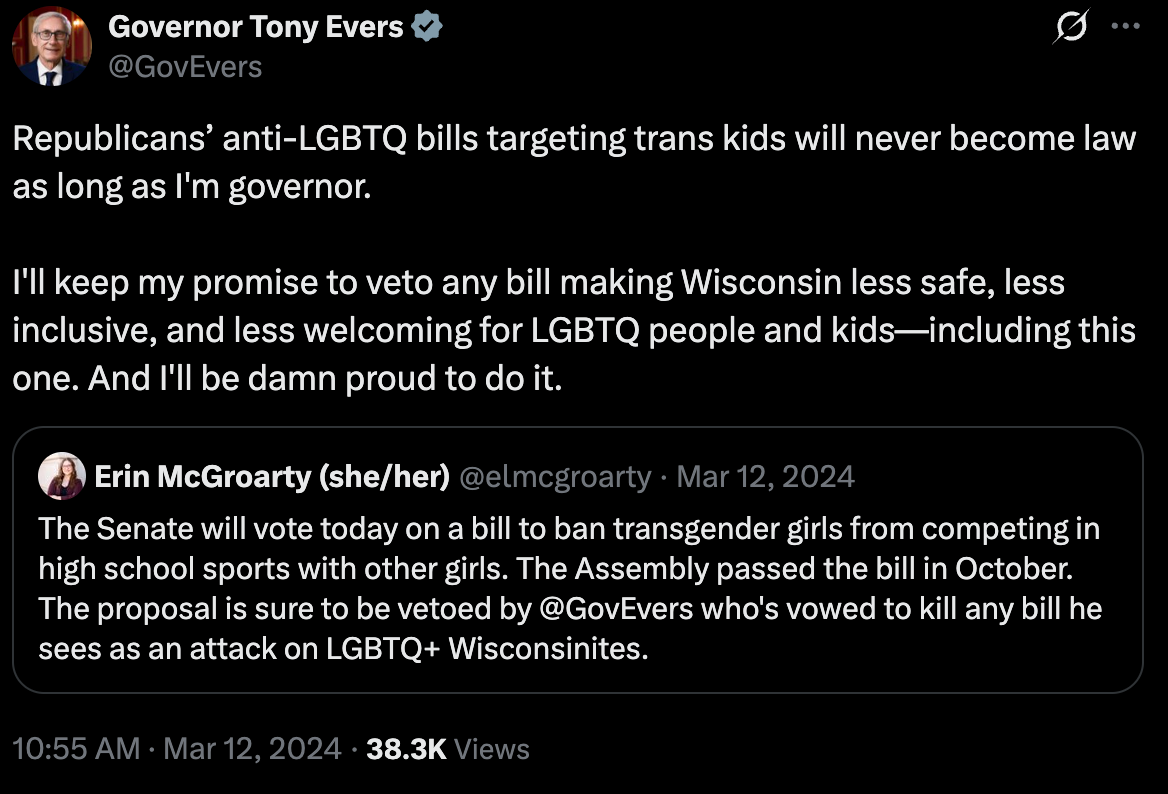
This is not the first time Evers has vetoed anti-trans and anti-queer legislation. In December 2023, Evers vetoed a Republican-backed ban on gender-affirming care for minors, and used his partial veto authority to protect Medicaid coverage for gender-affirming care in the state budget. In 2024, he vetoed a bill which would have banned transgender students from competing on sports teams that align with their gender identity. Throughout both rounds, Evers made his position unambiguous. "Republicans' anti-LGBTQ bills targeting trans kids will never become law as long as I'm governor," he wrote on social media in March 2024. "I'll keep my promise to veto any bill making Wisconsin less safe, less inclusive, and less welcoming for LGBTQ people and kids—including this one. And I'll be damn proud to do it."
Fair Wisconsin, a major LGBTQ+ civil rights and advocacy organization in the state, thanked Evers in a statement: "Thank you, Governor Evers, for supporting trans kids and standing for LGBTQ+ rights. You have built your professional life on doing what is best for kids, and you made good on that commitment by vetoing five bills; with these vetoes, you protected health care for trans kids and made sure they know they belong and are safe in our schools and welcome on our teams. These bills were always about more than health care, or the makeup of a sports team, or the use of pronouns in a classroom – they were about excluding trans people from public life, and we cannot allow that, especially when our trans community is being attacked by so many levels of government. But today, you made your support of Wisconsin’s trans community visible and meaningful. Our trans kids and their families are facing so much hate right now, and you have consistently chosen to lead with love. Thank you.”
The vetoes are almost certainly final. Wisconsin requires a two-thirds supermajority in both chambers to override a gubernatorial veto. Republicans hold an 18-15 majority in the Senate and a 54-45 majority in the Assembly—well short of the 22 and 66 votes needed, respectively.
Thank you Governor Evers. You have a stronger backbone than most of our U.S. Congress.
Sad these even reached his desk :/