

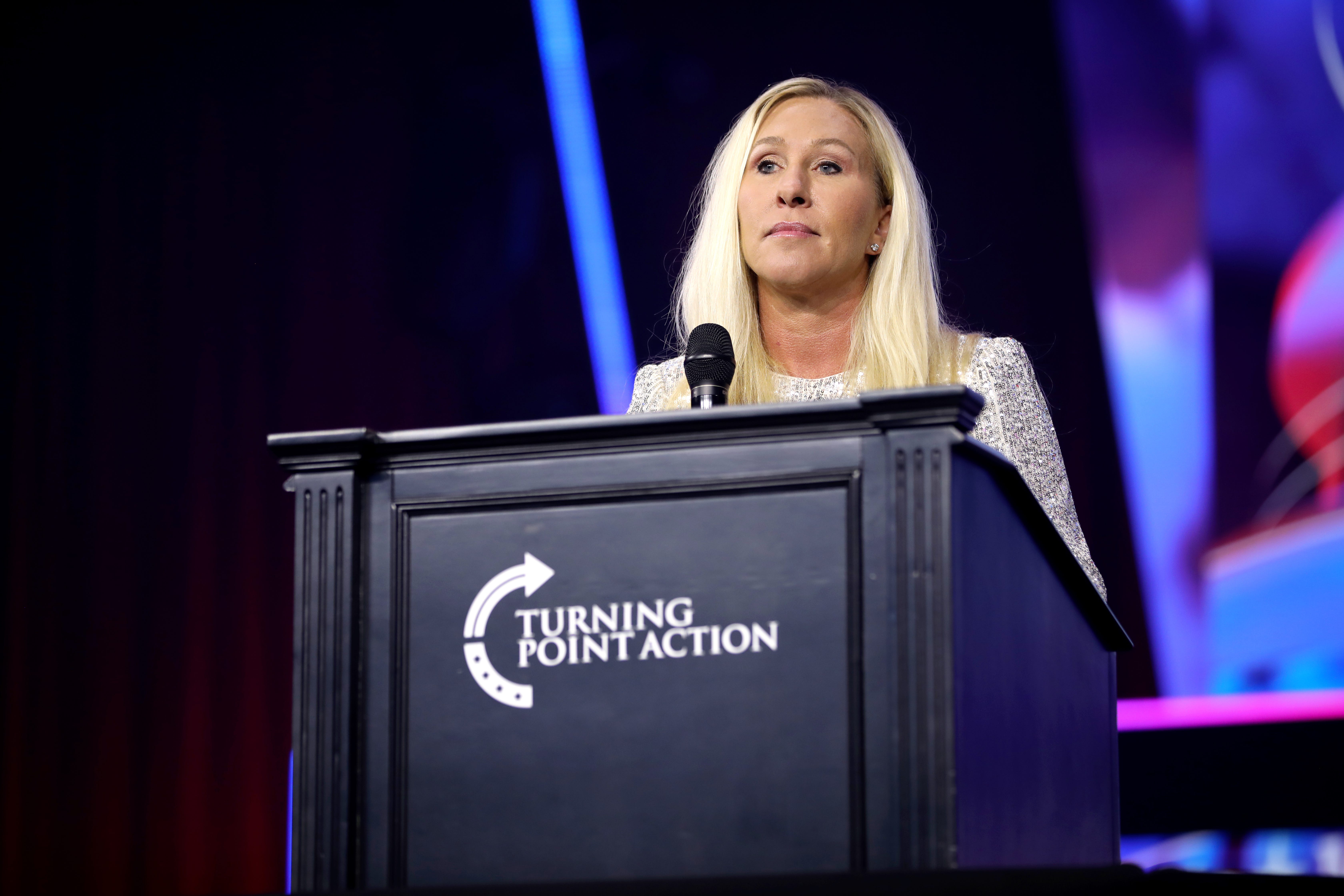
On Wednesday evening, Marjorie Taylor Greene announced that she had secured a commitment from House leadership: in exchange for her vote to advance the National Defense Authorization Act, a yearly bill that sets key parameters for the U.S. military, Congress would hold a vote on her long-running bill to criminalize gender-affirming care for trans youth. Greene has introduced versions of this legislation for years, but it has never before received a full House floor debate or vote. That will change on December 17, when the measure is expected to reach the floor, according to the ACLU.
The bill defines gender-affirming care for transgender youth as “bodily mutilation” and “chemical castration,” language that has no basis in medical evidence. Puberty blockers are fully reversible, fertility-preservation options exist for those who begin hormone therapy, and many transgender people remain fertile even after starting hormones. In reality, each transgender youth undergoes a careful, individualized process with their medical team—alongside their family and therapist—to assess the care they need and when they need it. The treatments are deliberate, measured, and closely monitored.
Despite this, Greene’s bill would upend the entire process and threaten every member of a young person’s care team with a Class C felony, punishable by up to 10 years in federal prison. The bill tracks closely with measures passed in several Republican-controlled states in recent years. And while no federal law currently authorizes a national ban on gender-affirming care, President Donald Trump has attempted to impose similar restrictions through executive fiat—moves that have already prompted some hospitals to preemptively comply, including LGBTQ+-focused systems such as Fenway Health in Boston.
“This extreme bill puts the threat of prosecution between hundreds of thousands of families and their doctors and would put doctors behind bars for exercising their best medical judgment,” said Mike Zamore, National Director of Policy & Government Affairs at the ACLU. “Every member of Congress who believes that health care decisions should stay between families and their doctors should vote no and vigorously oppose this bill’s passage. The fundamental equality of transgender people and our families is at stake now, but the implications of criminalizing health care could be far-reaching for everyone.”
The bill is unlikely to pass, as Senate Democrats have already rejected other anti-trans measures—including a nationwide sports ban in March, when not a single Democrat voted for cloture. Still, the vote will matter for two reasons: it will mark the first time a national trans youth care ban reaches the House floor, and it will serve as a revealing messaging vote for members of both parties. It will test House Democrats, many of whom are being pressed to capitulate on transgender rights by conservative forces in the party, and it will put pressure on House Republicans in vulnerable swing districts—places where anti-trans panic has not played well, as evidenced by recent Democratic wins in states like Virginia, where Republicans spent millions on anti-trans ads to little effect.
It also comes on the heels of a wave of anti-trans actions in Congress. In the recently passed National Defense Authorization Act, Democrats managed to strip out a trans healthcare ban that would have reshaped care for service members, contractors, and their families—though the bill still included a provision barring transgender service members from participating in sports. And just days ago, Republicans signaled they are willing to hold ACA healthcare funding relief hostage in exchange for a transgender care coverage ban for both youth and adults on ACA plans. During the shutdown fight, several appropriations bills were loaded with anti-trans riders, and at least one major House bill still carries such a provision—setting up a January endgame in which these measures will again have to be fought off.
Greene’s bill is expected to be brought to the House floor on December 17th, and many Congresspeople will need to be contacted to ensure that they do not support the bill. Previously, a handful of House Democrats have shown support for other anti-LGBTQ+ provisions primarily centering on transgender people: Henry Cuellar (TX), Donald G. Davis (NC), Cleo Fields (LA), Shomari Figures (AL), Laura Gillen (NY), Jared F. Golden (ME), Vicente Gonzalez (TX), Adam Gray (CA), Susie Lee (NV), John W. Mannion (NY), Marie Gluesenkamp Perez (WA), Kim Schrier (WA), and Thomas R. Suozzi (NY).
You can contact your representative and encourage them to vote against the bill here.
ANYONE who votes to make this a felony is a dumb political opportunist and/or simply a bigot.
Fair and simple.
Sigh…when is the pendulum gonna swing already?
I despise the attention the poor excuse for a legislator is getting from the Democrats. Will be making my calls.