


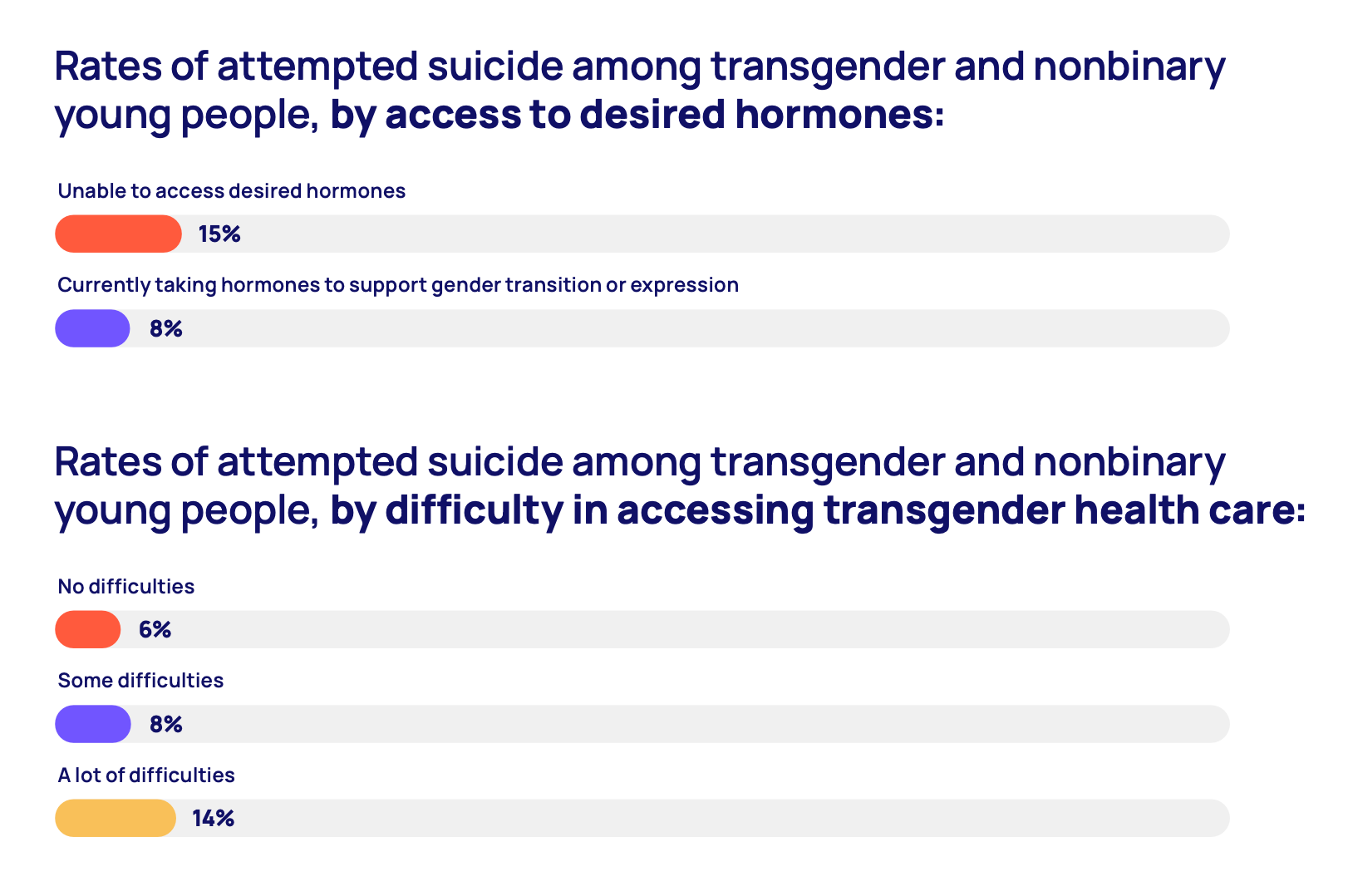
On Wednesday, the Trevor Project released a massive survey of LGBTQ+ youth, with one of the largest subsamples of transgender people of any survey previously recorded. The survey, which questioned 16,667 respondents, included over 10,000 trans, nonbinary, and genderqueer respondents. The survey found harsh experiences among LGBTQ+ people and especially transgender people, including high rates of bullying and harassment, difficulty accessing healthcare, and nearly a third of respondents saying anti-LGBTQ+ policies had made them or their families consider moving to a different state. Among the most significant findings, however, was the impact of access to gender-affirming care on transgender youth: transgender and nonbinary young people who wanted hormones to support their gender transition but were unable to access them were nearly twice as likely to report a past-year suicide attempt compared to those who were currently taking hormones.
"Transgender and nonbinary youth who reported being unable to access hormones to support their gender transition or expression were nearly twice as likely to report a past-year suicide attempt compared to those who were currently taking hormones (15% vs 8%)," reads the report. The finding is consistent with a growing body of peer-reviewed research linking anti-trans policies to worsening mental health outcomes. A 2024 study published in Nature Human Behavior—the first to establish a causal link between anti-trans laws and suicide risk—found that state-level anti-transgender laws increased past-year suicide attempts among trans and nonbinary youth by as much as 72%, with the highest increases among those under 18. The CDC's own Youth Risk Behavior Survey has documented similarly elevated rates, finding that over half of transgender high school students seriously considered suicide and more than a quarter attempted it during the rise in anti-trans legislation. Taken together, the evidence points in one direction: restricting access to gender-affirming care is harmful for transgender youth.
Importantly, the survey also showed that the vast majority of transgender youth do not have access to or are not taking hormones or puberty blockers. Among transgender and nonbinary respondents aged 13-17, only 10% reported taking hormones to support their gender transition. Among those 18-24, the number rose to 44%, still less than half. Just 3% reported taking puberty blockers. These numbers run counter to the political narrative that transgender youth are being rushed into medical intervention. The reality, according to the survey's own data, is that the overwhelming majority of transgender minors are not receiving hormones or puberty blockers at all.
For transgender youth who do have access to care, there is enormous anxiety over whether it will continue. Of the transgender and nonbinary youth currently taking hormones, 87% reported being concerned about losing access. Ninety percent of all LGBTQ+ youth said recent anti-LGBTQ+ laws, policies, and debates caused them stress or anxiety, and 94% of trans and nonbinary respondents answered likewise. Worse, 32% of LGBTQ+ youth said these laws and policies had made them or their families consider moving to a different state altogether. That finding is consistent with broader migration data: a Movement Advancement Project/NORC poll found 400,000 transgender people had relocated since the 2024 election alone.
The survey comes amid an unprecedented wave of attacks on transgender youth and their ability to access care. Over the last two years, the Supreme Court has greenlit a suite of anti-trans policies, including in United States v. Skrmetti, which upheld state bans on gender-affirming care for transgender youth. Several states, all Republican-controlled, have now banned such care. The Trump administration has gone further still, issuing the Kennedy Declaration to threaten hospitals' federal funding for providing care—a policy that caused more than 40 hospital systems to shut down their trans youth programs. Meanwhile, anti-trans pseudoscience groups are attempting to launder misinformation about care and push conversion therapy-like practices at major medical conferences. This survey cuts through the false claim by the far-right that their efforts are somehow protective of youth. Denying transgender youth who want hormones clearly does not help them, but rather, is associated with nearly double the rate of suicide attempts.
Gender-affirming care saves lives. A Cornell review of more than 51 studies found that such care significantly improves the mental health of transgender people. One major study reported a 73 percent drop in suicidality among trans youth who began treatment; another found a 40 percent reduction in actual suicide attempts in the previous year. Research published in the Journal of Adolescent Health in April 2024 showed puberty blockers sharply reduced depression and anxiety. Abroad, a German review backed by 27 medical organizations endorsed gender-affirming care for youth, and a recent French medical consensus did the same. The evidence has driven a historic resolution from the American Psychological Association—representing 157,000 members—formally condemning bans on trans care.
“Given the current climate in our country, it comes as no surprise that many LGBTQ+ young people are reporting high rates of anxiety, depression, and suicidality. Similar to previous research, this national survey demonstrates that LGBTQ+ youth experience these negative mental health outcomes not because of who they are, but because of how they are mistreated by others,” said Jaymes Black, CEO of The Trevor Project, in a press release. “These young people report they are being bullied, discriminated against, and debated about by politicians simply for being themselves. While many of these results are difficult to read, this year’s data point to a hopeful reality for LGBTQ+ youth in the U.S., too: When LGBTQ+ young people report they have welcoming and supportive communities, spaces, and people in their lives, their risk for attempting suicide lowers significantly. As adults and allies, this is our call to action: we must continue to vocally and visibly show the LGBTQ+ young people in our lives that they belong, exactly as they are.”
I knew who I was when I was three years old, in 1958. When I was twelve, I told myself it must not be true, that I was not a girl, but I knew I wasn’t a boy. Denial took over for decades. Youth now don’t have the lifesaving luxury - hollow as it is- of that denial. Even so, suicidal ideation was my constant companion. If I was a child or youth now, and HRT was withheld? I would never survive.
So - what this means is that the entire anti-queer, anti-trans, Christofascist and just plain bigoted crowd are actually, truly criminals. I'm not surprised, but I'm saddened - and enraged.