

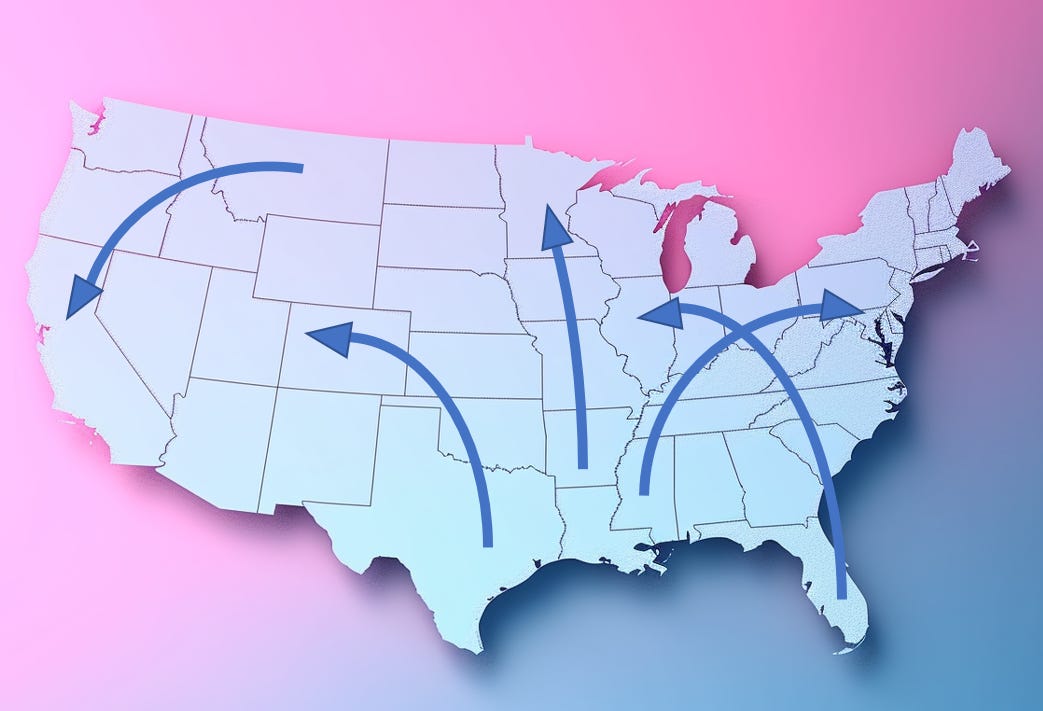
Across the United States, transgender people have been battered by a relentless wave of anti-trans legislation from Republican-led states. Under the Trump presidency, that pressure has only intensified, leaving transgender people increasingly dependent on whether their state government is willing to protect them or abandon them. While many states have weakened protections or embraced outright hostility, a smaller number have taken the opposite approach—suing the federal government, refusing to cooperate with discriminatory directives, and affirming trans people’s right to live freely. Transgender people are noticing. According to a new poll from the Movement Advancement Project and NORC, an estimated 400,000 transgender people have already fled their home states for safer ones since the 2024 election, relocating specifically in response to anti-trans laws and policies, making it among the largest relocations in modern history in the US.
Surveyors at the Movement Advancement Project polled more than 1,000 LGBTQ+ households, asking respondents about their perceptions and actions since the 2024 election. When asked whether they had moved to a different state, 9% of transgender respondents said that they had. That figure translates into a striking level of displacement. According to Gallup, transgender people make up roughly 1.3% of the U.S. population—about 4.5 million people nationwide. If 9% of that population has moved states, it amounts to approximately 401,000 transgender people relocating in the wake of the election, an extraordinary migration driven by political conditions rather than personal preference.
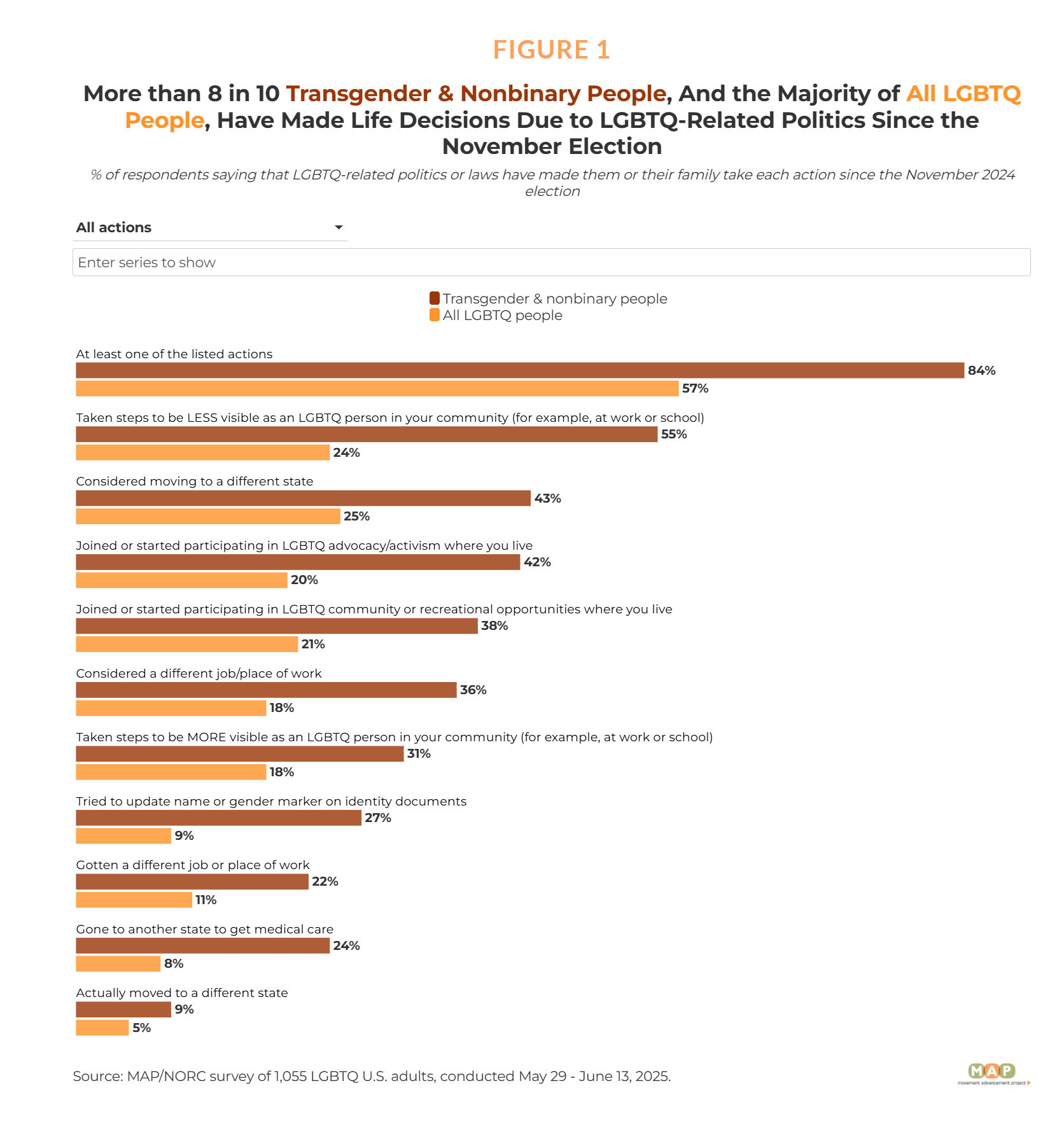
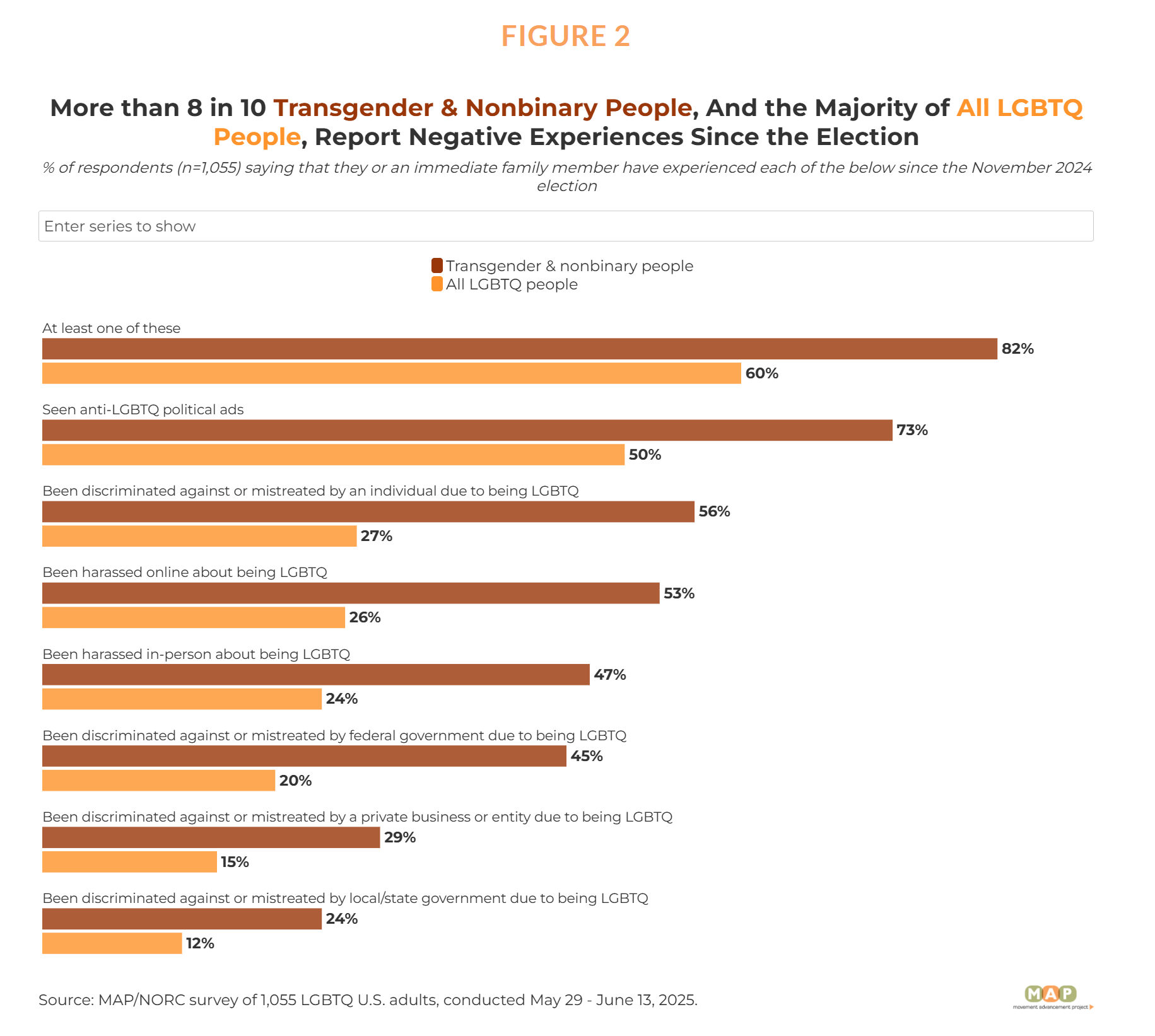
The likely reasons for this movement appear later in the survey. Transgender people report experiencing startling levels of discrimination in the aftermath of the 2024 election. More than half—56%—said they have faced discrimination because of their gender identity, while 47% reported being harassed in person. In many cases, that hostility is coming directly from the state itself: 24% of transgender respondents said they were discriminated against or mistreated by their local or state government. Faced with conditions like these, which can make even day-to-day life a struggle, relocation becomes less a choice than a means of survival.
The movement is not limited to transgender people. A far larger number of LGBTQ+ people overall have also changed states since the Trump election. While the percentage is smaller—about 5% of non-transgender LGBTQ+ respondents—the raw numbers are much larger, translating to roughly 1.5 million people relocating across state lines since the election. Their reasons closely mirror those cited by transgender respondents: widespread harassment, persistent discrimination, and a growing sense that remaining in place has become untenable.
This is not the first survey to document this kind of movement. In 2023, Data for Progress examined transgender migration in the aftermath of harsh anti-transgender legislation passed at the state level, and found similarly large numbers of transgender people reporting that they had moved to a different state as a result. While the Movement Advancement Project survey focuses only on migration since the 2024 election, the broader pattern is clear: this migration has been underway for several years, and the true number of transgender people who have relocated in response to hostile policy environments is likely far larger than any single survey can capture.
I’ve created a migration map based on a smaller survey I’ve conducted with 135 respondents so far.
Texas is the top most fled state.
If they’ve fled blue states it’s usually to live abroad. If they’ve fled red states it’s usually for blue states.
You can read more about the my data here:
https://open.substack.com/pub/transcollective/p/where-do-trans-americans-go-when?r=1vacxf&utm_medium=ios&shareImageVariant=overlay
I apologize in advance if this is a mischaracterization, but the trans migration seems similar to when black people fled the South during Jim Crow because they were being terrorized by their government and racist citizens.
(Not saying the subjugation of black people in the US is a thing of the past by any stretch of the imagination; the reality is that it has been resurrected and it’s ongoing.)