

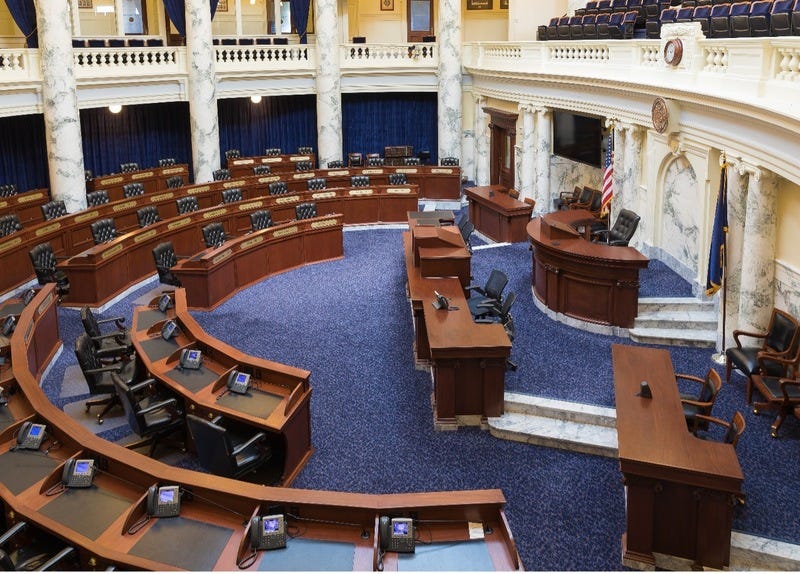
Anti-transgender bills have moved across the United States this year, and they have seen expanded enforcement mechanisms and scopes never before seen in previous years, making them the latest vanguard of anti-transgender legislation. Earlier this year, Kansas passed a bill that mass-invalidated transgender people's driver's licenses and created a bathroom bounty hunter system across the state. Missouri then advanced three anti-transgender bathroom bills in a single night. Now, Idaho has gone even further than these extreme bills in other states, with its House passing a bill that would ban transgender people from public bathrooms, including private business bathrooms, with a second-offense felony carrying up to a five-year prison sentence. The bill now will move to the Senate, which will could take up the measure in the coming weeks.
The bill, HB 752, states that "any person who knowingly and willfully enters a restroom or changing room in a government-owned building or a place of public accommodation"—a category that includes private businesses—"designated for use by the opposite biological sex of such person shall be guilty of a misdemeanor" punishable by up to one year in prison. A second offense within five years would be a felony carrying up to five years in prison. The bill would amend Chapter 41 of Title 18 of the Idaho Code, the state's indecency and obscenity statutes, adding a new Section 18-4117—classifying a transgender person's use of a public restroom alongside offenses like voyeurism and indecent exposure.
The bill, which was debated Monday, drew heavy criticism from the few Democrats who occupy seats in the Idaho legislature. "The truth of the matter is—and I know a lot of people don't want to say it, but—forcing people who don't look like the sex that they were born with, or transgender folks, forcing them to use other people's bathrooms is going to put a lot of people in danger," said Rep. Chris Mathias, a Boise Democrat. He continued: "If a Klansman comes into the bathroom in a full robe and hood, I'm going to be a little fearful. But if all he does is walk into the bathroom, use it, and wash his hands, do we want to criminalize that? I do…" (laughter from the House) "…but do we?" The bill then passed 54-15, with six Republicans joining the state's nine Democrats in opposition.
The bill contains two provisions that make it more extreme than other states that have passed public bathroom bans. The first is that the bill simply makes "knowing entry" into a bathroom that does not match a person's assigned sex at birth a crime. This distinguishes it from Florida's bathroom ban, which passed in 2023, and contains a "duty to depart"—a provision that allows a transgender person to avoid criminal charges if they leave after being asked to do so by a government employee. No such provision exists in the Idaho bill, meaning a transgender person could be arrested on the spot simply for being present in a restroom. That fact earned the bill opposition from both the Idaho Fraternal Order of Police and the Idaho Sheriffs' Association, who asked lawmakers to add a duty-to-depart amendment, which was rejected.
"Officers responding to a complaint would be placed in the difficult position of determining an individual's biological sex in order to enforce the statute," wrote Idaho Fraternal Order of Police President Bryan Lovell. "In many circumstances, there is no clear or reasonable way for officers to make that determination without engaging in questioning or investigative actions that could be viewed as invasive and inappropriate."
The second provision is even more extreme. In addition to making a second offense a felony, the bill states that prior convictions under "a similar statute in another state, or any similar local ordinance" would count toward the escalation threshold—meaning that if a transgender person had previously violated a bathroom ban in another state or a local ordinance in another jurisdiction, their first offense in Idaho could be charged as a felony, similar to how prior-offense drug convictions in other states operate. The bill does not specify how such cross-jurisdictional adjudication would work, a significant gap given that bathroom bans across the country employ wildly different enforcement mechanisms—ranging from civil fines to bounty-style lawsuits against the entity that owns the facility rather than the individual. The practical result is that a transgender person who has never set foot in an Idaho restroom could face up to five years in prison for doing so once.
The bill is the latest in an accelerating wave of legislation targeting transgender people for using the bathroom. In the 2021–2023 period of anti-transgender lawmaking, bills focused primarily on school sports, school bathrooms or the medical care of transgender youth. The current generation of bills has moved well beyond that. States like Florida, Kansas and Texas are now pursuing the full-scale criminalization of transgender adults using bathrooms in public buildings, each enacting more extreme enforcement mechanisms than the last—from Florida's criminal trespass arrests to Kansas's bounty hunter lawsuits and mass license revocations. Those states now carry a "do not travel" rating on the Erin in the Morning trans legislative risk assessment map, and Idaho could become the next if this bill clears the Senate, as the map of where transgender people can safely travel shrinks year by year.
“Bathroom laws don’t improve safety and privacy in public restrooms. They only serve to exclude transgender people from public life and put them in dangerous situations….these bans only serve to discriminate against the trans community by stripping them of their dignity and bodily autonomy and fueling a dangerous narrative that merely encountering a perceived trans person in public is damaging,” said ACLU Idaho about the bathroom bills moving through the state.
The bill now heads to the Idaho Senate, where Republicans hold a 29-6 supermajority. Governor Brad Little, a Republican, has not indicated whether he would sign or veto the measure if it reaches his desk. A separate bathroom ban bill, HB 607, which targeted private businesses through a civil lawsuit mechanism, passed the House last month but has not received a Senate committee hearing.
Another day, another fresh new level of hell to uncover.
If you’d like to focus some love towards supporting and uplifting 2 trans Girl Scouts, I’ve got 2 on Erin’s list still trying to reach their cookie goals -
https://digitalcookie.girlscouts.org/scout/steele757911
https://digitalcookie.girlscouts.org/scout/armando152892
Crazy and punative as these bans are. I believe they are all ultimately unenforceable. What, are all women going to be required to carry their birth certificates with them. Mine says I was born female. Or will all women be required to drop trow or lift skirt. In which case, what of those of us who have had bottom surgery?