

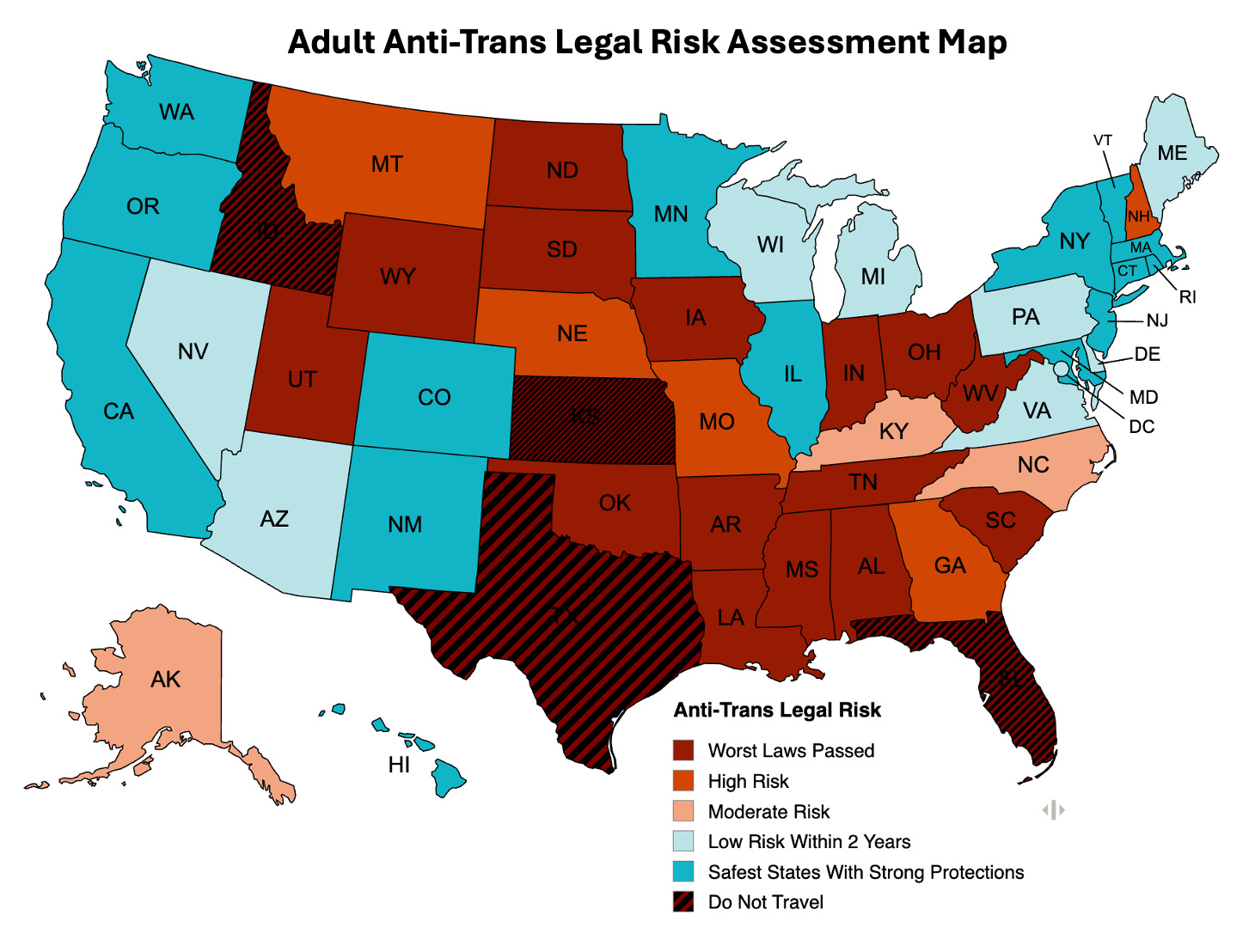
Short summary of updates: The legislative season of 2026 in state legislatures has led to continued degradation of transgender rights across the United States. Meanwhile, nationwide, federal policies continue to lead to enormous legal difficulties for transgender people. In the latest update, Idaho becomes the fourth-ever “Do Not Travel” state for transgender people, and may be the harshest of all such states, where bathroom usage can lead to 5-year prison sentences. Meanwhile, South Carolina expanded its bathroom ban to universities, causing its risk to rise to “Worst Laws Passed.” For youth, the map remains relatively unchanged, with Idaho likewise elevating to “Do Not Travel.”
About The Map
I have tracked anti-transgender legislation for 5 years. Every day, I’ve gotten messages from worried people wondering how they are supposed to assess their risk of staying in their home state. The messages range from parents of trans youth wondering if their children will be taken from them to trans teachers wondering if their jobs will be safe in coming years. Sometimes people just want to know if there is a safer state they can move to nearby.
I created the legal risk map specifically to help answer that question. Now more than ever, it is a question that needs answering for so many transgender people facing forced medical detransition, arrests for using the bathroom, bans on the use of our names, pronouns, and identification documents, and many other curtailments of our rights to exist in public life.
Methodology
The methodology used is primarily qualitative, with a scoring-rubric element for the worst bills. Part of the methodology is my own expert assessment of laws, of which I am well equipped to do. I have read thousands bills targeting transgender people in the last few years. I have watched hundreds of hours of hearings on anti-trans legislation and am fully aware of all of the players nationally as well as where they are making their pushes against trans rights. I have followed the vote count and regularly talk to activists on the ground in each state. I am looking at how similar states are moving in their legislative cycles. Lastly, I watch for statements by governors and bill drafts to see if the Republican party in various states seems to be pushing anti-trans legislation heavily - you can see many examples of such legislation in this newsletter.
In terms of actual laws, I keep a rubric of the various types of laws that target transgender people. For transgender youth, the most concerning laws are those that prohibit gender-affirming care and mandate medical detransition. Additionally, bathroom bans, laws that rigidly define sex as binary, and restrictions on social transition are other key factors that negatively impact a state’s ranking. For transgender adults, the primary legislative concerns include adult gender affirming care bans, bathroom bans, prohibitions on drag specifically aimed at trans people and pride events, restrictions on changing birth certificates and drivers licenses, and laws that end legal recognition for trans people entirely. These factors play a significant role in how I assess and rank a state’s legislative risk.
The Adult Trans Legal Risk Assessment Map
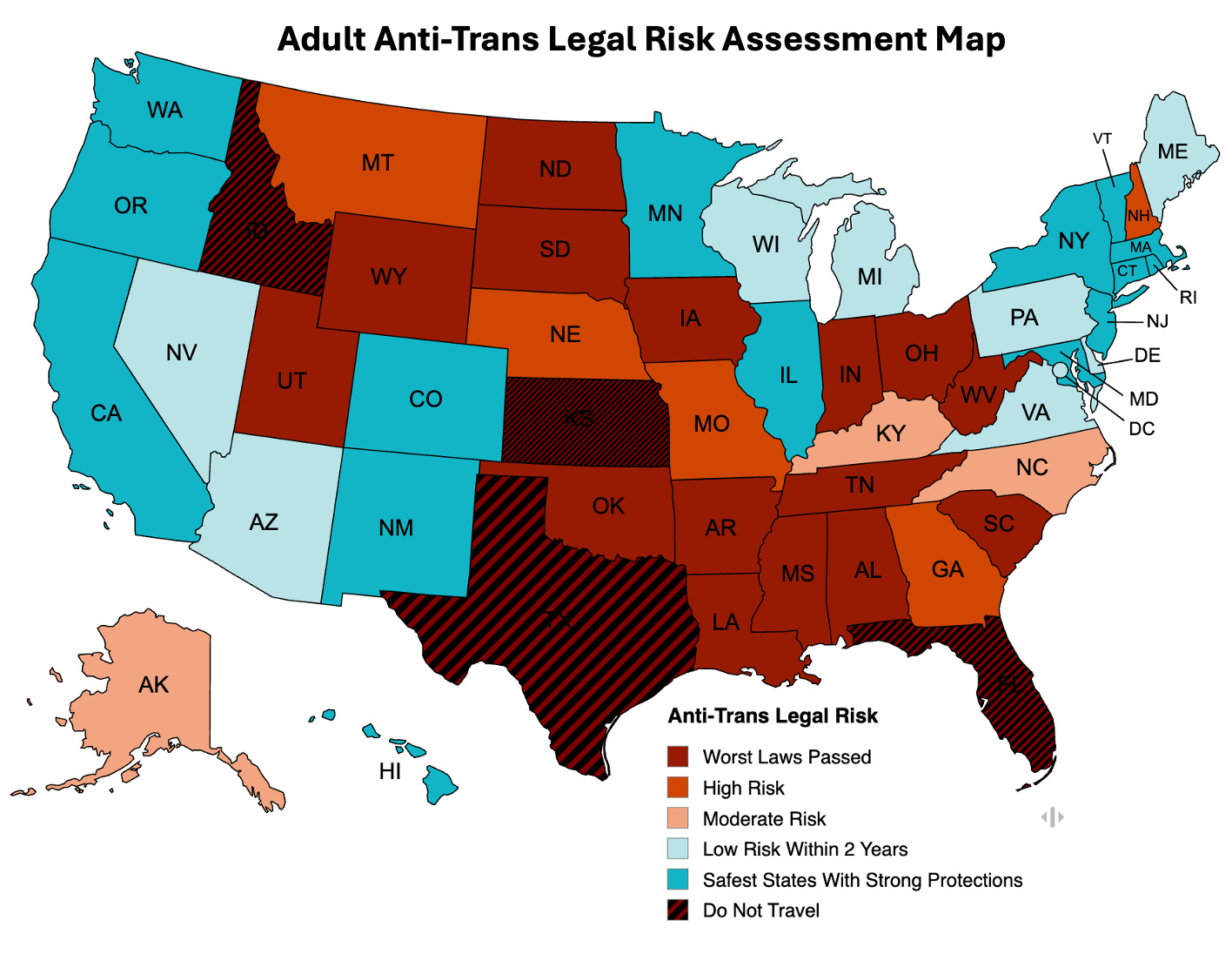
Moves in this update: Idaho (Worst Laws → Do Not Travel), South Carolina (High Risk → Worst Laws)
Summary of updates: Idaho has moved into the highest risk level on this map, “Do Not Travel.” This is not an move ever taken lightly. However, with the passage of Idaho’s felony bathroom ban with up to 5 year prison sentences, the state firmly belongs in this category. Though a lawsuit has partially blocked the law, the law remains in effect anywhere a gender neutral or family restroom exists, meaning transgender people must search for a gender-neutral restroom or else they might risk a felony in Idaho. In South Carolina, the bathroom ban there has been expanded to colleges and universities, raising the risk level in the state.
Nationwide Risk: Worst Policies In Effect. The wave of executive orders targeting transgender Americans has reshaped the national landscape in chilling fashion. These directives have forced nonprofits to scrub the word “transgender” from their websites, stripped transgender history from the Stonewall National Monument, withdrawn federal funding from schools and hospitals that recognize or research transgender people, and imposed new barriers to obtaining passports and legal documents. The result is a sweeping, nationwide rollback of rights and recognition for transgender adults. For international visitors, the risk is even more severe: citing the sharp escalation in legal and bureaucratic targeting, several countries have issued travel advisories. Following suit, I’ve designated the United States a “Do Not Travel” zone for non-essential travel for transgender people without a full understanding of the legal environment, due to the heightened risk of visa revocation, denial of entry, or detention.
Here are the categories and where each state falls:
Do Not Travel (FL, ID, KS, TX): Four states have earned “Do Not Travel” advisories: Idaho, Florida, Kansas, and Texas. Kansas bathroom ban allows for everyday citizens to seek out transgender people in bathrooms and sue them for large sums of money, creating a bounty hunter system in the state. Meanwhile, Idaho’s ban can result in 5-year prison sentences. Florida has a law that allows for the arrest of transgender people for using bathrooms according to their gender identity and another policy targets transgender people’s drivers licenses. Florida has also put into effect a policy that says trans people “misrepresenting” their gender on their drivers license could be guilty of fraud and has begun erasing Pride crosswalks across the state. Local LGBTQ+ orgs as well as HRC have issued travel advisories for the state. This analysis likewise concurs with such a rating. In Texas, the state is not only ignoring court ordered drivers license changes for trans adults, but it is also creating a database of people attempting to make such changes. A new statewide bathroom ban that has already resulted in detainment makes the state the Do Not Travel on this list.
The Worst States (AL, AR, IA, IN, LA, MS, OH, OK, ND, SC, SD, TN, UT, WV, WY): These states have passed deeply troubling legislation targeting transgender adults in extremely harmful new ways. Utah has a bathroom ban for transgender adults. Alabama has also passed a Don’t Say Gay bill that includes a bathroom ban on college campuses. Many states, including Louisiana, Mississippi, Oklahoma, and Tennessee, and others listed in this category have gone so far as to legislatively erase transgender people, effectively removing any legal rights associated with their gender identities. Other states, such as North Dakota, Oklahoma, and Tennessee, prohibit any changes to birth certificates, forcing trans people to out themselves when showing their documents. These states also could start targeting adult gender affirming care - Florida has already done so, banning 80% of such care.
High-Risk States (GA, MO, NE, NH, MT): All of these states have passed anti-trans laws, but they haven’t reached the same level of severity as the worst states. Missouri for example, prohibits gender-affirming care for incarcerated adults as well as transgender youth and have seen new laws proposed this cycle going even further. Nebraska’s governor has issued an executive order ending legal recognition of trans people. Additionally, some of these states have laws that permit the refusal of medical care to LGBTQ+ individuals on religious grounds. Although each of these states has laws targeting transgender adults, none have done so to the extent of the worst states. Montana is a special case on this list, in that it has passed laws that would normally place it among the worst states, but those laws have repeatedly been blocked in court.
Moderate-Risk States (AK, KY, NC): These states have either passed one or two laws aimed at transgender adults or have enacted multiple laws targeting transgender youth, or are advancing negative laws quickly. For states focusing on trans youth, history shows they are more likely to introduce anti-trans legislation for adults in subsequent years. Most of these states are under Republican control, either through supermajorities in the legislature or Republican governorships. Many have enacted “Don’t Say Gay” provisions, which frequently result in the banning of transgender teachers. Additionally, many have passed religious refusal rights bills. However, most of these states have either not yet ventured into anti-trans adult legislation or have only passed milder forms of such laws.
Low-Risk States (AZ, DE, ME, MI, NV, PA, VA, WI, DC): These states have largely refrained from targeting transgender adults, although they haven’t taken extraordinary steps to protect adult transgender rights either. For example, Arizona and Virginia have enacted anti-trans policies affecting youth but, due to state-specific factors, appear unlikely to extend such policies to adults. Conversely, Michigan, and Nevada have enacted fairly robust non-discrimination policies but fall short in ensuring healthcare equity and providing protections for incarcerated transgender individuals. Maine has increased in risk due to capitulation to Trump over sports bans in the University of Maine system. While these states generally offer a safer environment for transgender adults, they stop short of going the extra mile to make their jurisdictions unequivocally safe places to reside. In the case of the District of Columbia, it may fall under attack from Congress and executive actions, meaning it can no longer be considered “most protective.” This most recently was manifested with the DC House bathroom ban.
Most Protective States (CA, CO, CT, HI, IL, MA, MD, MN, NJ, NM, NY, OR, RI, VT, WA): These states have gone above and beyond in safeguarding the rights and well-being of transgender individuals, making them highly desirable places to live for those in search of security. States like Colorado, Hawaii, Maryland, and Washington have enacted comprehensive health insurance laws that cover facial hair removal and an expanded range of medical procedures. Each of these states offers refugee protections for individuals fleeing more repressive states with anti-trans laws. Care is not only supported but also enjoys legal reinforcement from the state, ensuring accessibility as long as such treatments remain lawful at the national level. These states are the most likely to counteract federal anti-trans regulations.
The Youth Trans Legal Risk Assessment Map
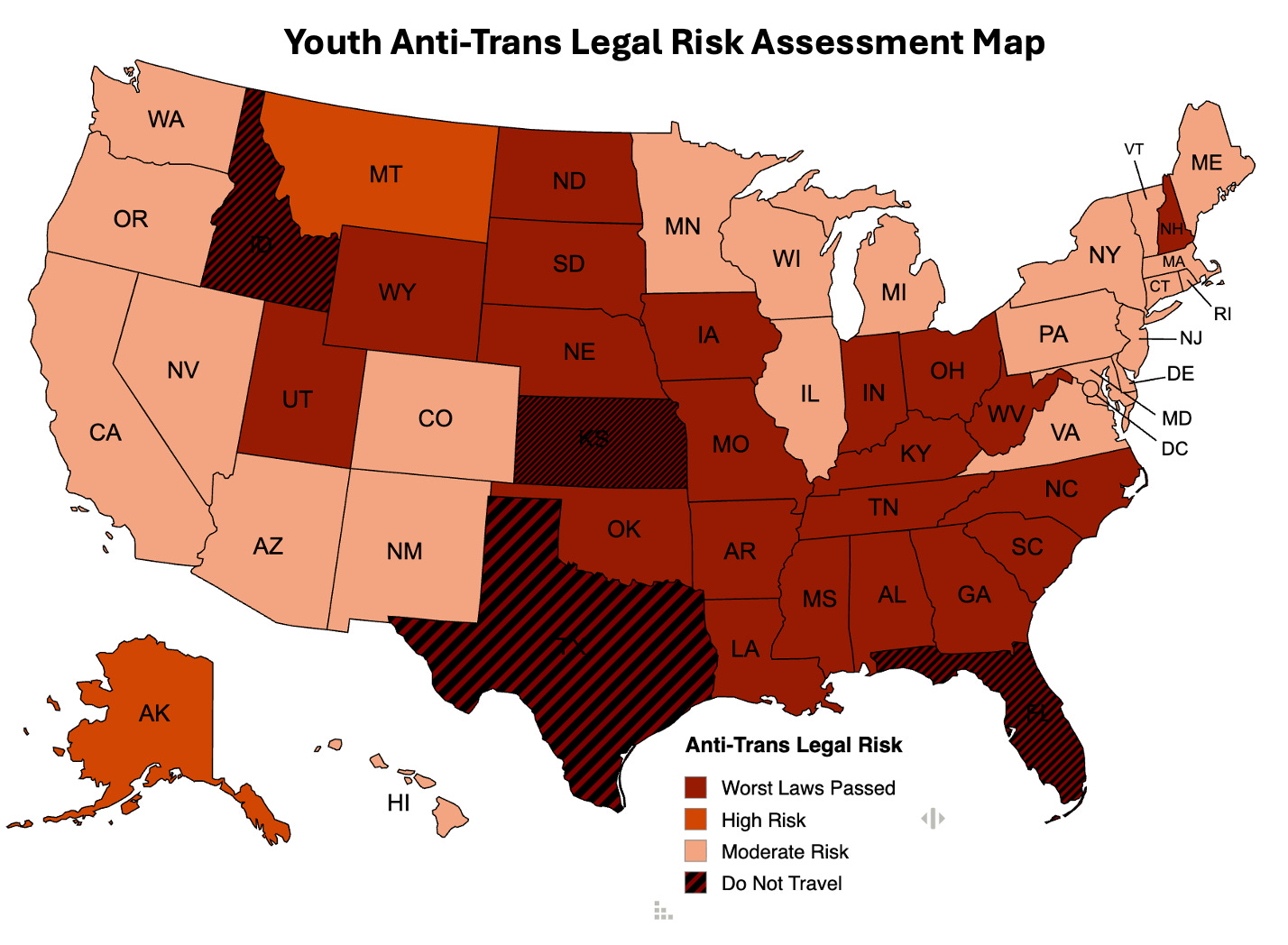
Moves in this update: Idaho (Worst Laws → Do Not Travel)
Summary of updates: This map quite closely resembles the last map published with respect to youth. No state in the United States can be considered low-risk for transgender youth, due to federal policies and mass capitulation to Trump’s threats with respect to sports and healthcare bans. Meanwhile, a recent Title IX SCOTUS decision raises the risk of anti-trans policies in blue states in the coming months. As such, the country remains between Moderate Risk and Do Not Travel depending on the state.
Nationwide Risk: Worst Laws Passed. A wave of executive orders has targeted transgender youth in sweeping and extreme ways. Nonprofits have halted services for trans youth, healthcare providers face federal bans via executive orders, and teachers have been warned they could be investigated for “practicing medicine without a license” simply for using a trans student’s chosen name. The cumulative effect is a chilling rollback of basic recognition and care—one that signals even more punitive measures may be on the horizon.
Every time this map comes out first thing I do is look at my blue state. Next thing I do is see how much less of the nation I can safely travel within. This is not how individual liberty and equal justice works. This is exactly opposite of equal justice. This destroys individual liberty.
All of these laws restricting trans people’s freedoms are accumulating into a major generational trauma whose impact won’t be just felt among our community, but in other areas such as economy, healthcare, arts and science. It will weaken the foundation of the United States, impacting every person living here, trans or not.