

On Wednesday, Erin in the Morning was the first to report that transgender residents across Kansas were receiving letters demanding the immediate surrender of their driver's licenses. The letters were triggered by a new law that had just gone into effect, House Substitute for Senate Bill 244, which immediately invalidated driver's licenses for transgender people and enacted what may be the harshest bathroom ban in the nation. The law and the speed at which it began impacting people left transgender Kansans scrambling and stunned commentators who were unaware of the serious escalation targeting transgender people in the state. Now, the ACLU has filed a lawsuit in Kansas state court to block the law. If successful, the challenge could buy transgender residents time or see the law overturned altogether.
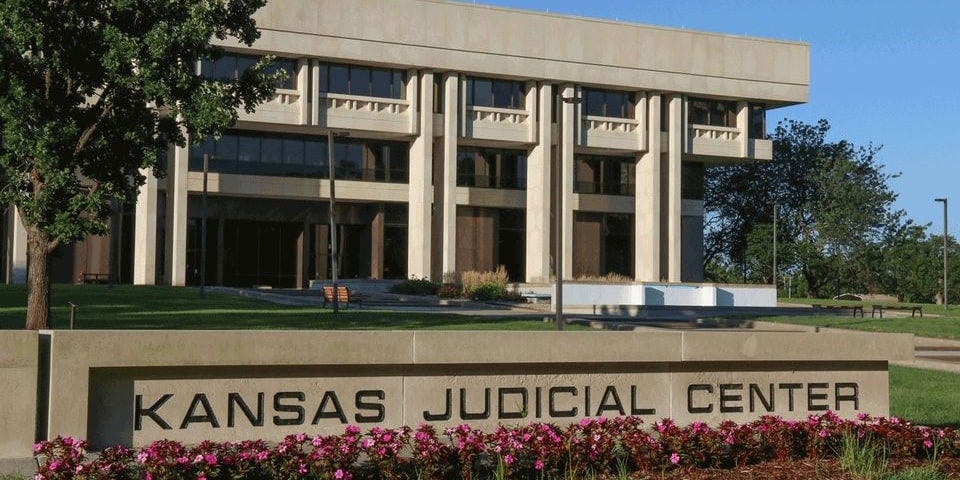
The lawsuit, Doe v. State of Kansas, was filed on February 27 in the District Court of Douglas County by the American Civil Liberties Union, the ACLU of Kansas, Stinson LLP, and Ballard Spahr LLP. It was brought on behalf of two anonymous plaintiffs, Daniel Doe and Matthew Moe, both transgender men living in Lawrence, Kansas. The complaint challenges SB 244 on six grounds under the Kansas Constitution, alleging violations of due process, personal autonomy, informational privacy, equal protection, freedom of expression, and the state's single-subject rule. The plaintiffs are seeking a temporary restraining order to block the law immediately, followed by a permanent injunction.
The lawsuit challenges SB 244, a bill that was rushed through the Kansas Legislature in January. Governor Laura Kelly vetoed the bill on February 13, but the legislature overrode her veto five days later. The law is sweeping in its impact on transgender people. It retroactively invalidates driver's licenses that display a gender marker reflecting a transgender person's gender identity, ordering the state Division of Vehicles to demand their surrender, which appears to have occurred on Wednesday as thousands of transgender Kansans got letters demanding just that. It bans transgender people from using restrooms that match their gender identity in government buildings—a category that extends to libraries, courthouses, state parks, hospitals, and interstate rest stops—with criminal penalties including jail time. And most significantly, the bill creates a private "bathroom bounty hunter" provision allowing anyone encountering a transgender person in a restroom—including potentially in private businesses—to sue them for large sums of money.
The lawsuit is being brought by two anonymous plaintiffs, both transgender men. Both hold driver's licenses with male gender markers. SB 244 retroactively invalidates those licenses, which will "forcibly out Plaintiffs as transgender." One plaintiff, Daniel Doe, is an administrative associate at the University of Kansas whose job requires him to drive university vehicles twice daily. The other, Matthew Moe, is a PhD student who works at a local bar and frequently ends shifts at 3 AM—without a valid license, he would be forced to bicycle home at unsafe hours. The bathroom provisions are equally punishing to the plaintiffs. SB 244 places both men in what the complaint calls an "untenable and dangerous position." If they continue using the men's restrooms as they have for years without incident, they risk fines or misdemeanor charges. If they begin using the women's restrooms, they will be immediately outed as transgender—and may still face confrontation or lawsuits. As the complaint states, they "may be harassed and targeted for violence, and may still be sued by individuals who are 'aggrieved' because they think they're in the wrong restroom."
The filing argues that the law violates the plaintiffs' rights in at least six ways. One claim is that the law failed to give transgender residents sufficient notice or opportunity to comply, given that driver's licenses were invalidated immediately with no grace period. Another argues that SB 244 violates the Kansas constitutional right to personal autonomy and self-determination. A third claims it violates the right to privacy by forcing transgender people to disclose their transgender status every time they present a license. The complaint also alleges that the law violates the right to equality under the law: because SB 244 imposes a sex-based classification, it must survive intermediate scrutiny under state precedent, meaning it must be substantially related to an important government objective—a test the ACLU argues it cannot pass. The filing further contends that the law violates transgender residents' right to free expression by compelling speech through their driver's licenses. Finally, it argues that the law itself was passed in an unconstitutional manner, with legislators logrolling multiple unrelated subjects into a single bill—a violation of the Kansas Constitution's single-subject rule.
It is notable that the lawsuit was filed in state court, not federal court. The United States Supreme Court has grown increasingly hostile to transgender rights, allowing the Trump administration's transgender passport restrictions and state gender-affirming care bans to go into effect. Filing under the Kansas Constitution rather than the federal one insulates this challenge from federal review entirely. The Kansas Supreme Court, which is likely to eventually hear this case, holds a comfortable liberal majority and has repeatedly ruled against Attorney General Kobach, who has publicly complained that the court's composition makes it "very difficult" for him to win cases. The state-court strategy also follows a path that has already produced results for transgender people in other red states. In Montana, for instance, state courts have blocked a transgender youth healthcare ban, struck down a bathroom ban, and ordered the state to issue accurate driver's licenses to transgender residents. As federal courts become less hospitable, state constitutions may increasingly become the last line of defense.
Now, transgender Kansans face a difficult choice. They can surrender their driver's licenses immediately and comply with the law, or they can hold onto them and hope that the court enjoins the state from enforcing SB 244 before they are pulled over. Driving on a revoked license carries criminal penalties—a class B misdemeanor punishable by up to six months in jail and a $1,000 fine—and Kansas already requires county jails to house inmates according to sex assigned at birth. But surrendering a license may complicate their ability to obtain relief should a temporary restraining order be issued. Numerous transgender residents have reported that they are considering leaving the state altogether, though for many that is not an option. For now, all eyes are on the Douglas County District Court.
Thank goddess for the ACLU-
Thank you for keeping us updated on the criminal behavior of those “in charge”. Interesting that the decision to revoke licenses of transgendered individuals arose from a “committee” rather than putting it on a valid state wide ballot. This action, once again, attempt to limit the voice of the People. That shit will not survive the tenacious sane population of Americans. Donating to the ACLU….
Weary but fierce!