


At EITM, we often report the connections between voter disenfranchisement and the abandonment of procedural norms in relation to anti-trans laws. In state after state, politicians have used gut-and-go procedures to get anti-trans measures passed with little voter input, attaching them to unrelated bills in undemocratic processes. Now, those tactics are moving to Congress. Trump is demanding that his favored legislative vehicle, the SAVE America Act—a mass voter disenfranchisement bill that would end mail-in ballots and impose strict voter ID requirements—also contain a nationwide trans sports ban and a ban on gender-affirming surgery for transgender youth.
Those provisions are not currently in the bill text. But the pressure campaign to pass them is escalating fast. Trump’s Republican allies are pushing a “talking filibuster” maneuver that analysts at the Bipartisan Policy Center say would be tantamount to the nuclear option, allowing the measure to pass with just 51 votes, neutralizing Senate Democrat’s ability to block bills. And this week, Sen. John Cornyn—one of the Senate’s longest-standing defenders of the filibuster—reversed his position entirely, saying he now supports “whatever changes to Senate rules that may prove necessary” to pass the bill. Though analysts still say that the votes are not there to do this, the gap appears to have narrowed, and it would not be the first time Republicans ditch historic precedent to pass anti-trans measures.
Trump first posted his anti-transgender demands to Truth Social on March 5, listing "NO MEN IN WOMEN'S SPORTS" and "NO TRANSGENDER MUTILATION SURGERY FOR CHILDREN" alongside voter ID requirements. That last demand had originally included the caveat "WITHOUT THE EXPRESS WRITTEN APPROVAL OF THE PARENTS," which led to a brief moment of confusion among far-right influencers as it indicated he might support gender-affirming care with parental consent.
The confusion quickly turned to Trump deleting the post and putting it back up without the parental consent language. He has since escalated the rhetoric repeatedly—telling House Republicans on Monday that he wanted to add "no men in women's sports and no transgender mutilation of our children," calling the additions "best of Trump." At a press conference yesterday, he repeated the demand: "We want no transgender mutilization [sic] of your children." The White House has formally confirmed the anti-trans additions as presidential priorities, with press secretary Karoline Leavitt stating, "We are not gonna tolerate the mutilation of young children in this country."
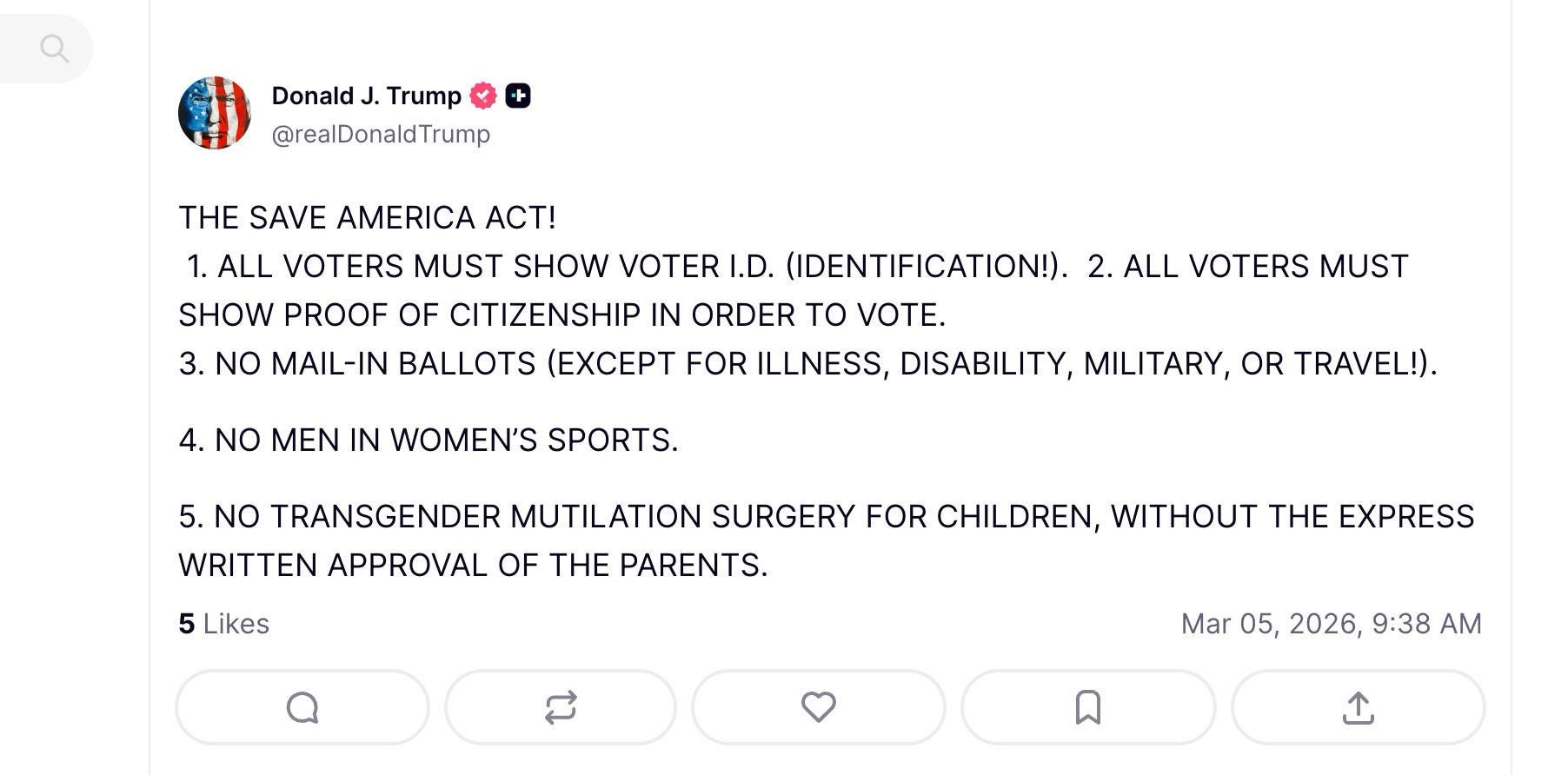

The demands are significant because anti-transgender measures have repeatedly failed to survive the legislative process in Congress. The filibuster previously kept a transgender sports ban from passing the Senate, and Democrats have used their leverage to block several other measures. In the "One Big Beautiful Bill" reconciliation fight, Republicans tried to include a ban on Medicaid funding for gender-affirming care for all ages, but the provision was struck down by the Senate Parliamentarian under the Byrd Rule. And recently, Democrats successfully stripped every major anti-trans provision from appropriations bills during the recent shutdown fight. Attaching anti-trans provisions to the SAVE America Act is the newest attempt by Republicans to push these measures through, this time with serious pressure to drop the filibuster and attached to Trump’s most important policy priorities.
The pressure over the filibuster is notable. For years, the filibuster has kept a 60-vote threshold for most legislation, giving the minority party power to block bills when the majority holds all three branches. That filibuster has been whittled down—Democrats lowered the threshold for most judicial and executive nominations in 2013, and Republicans extended that to Supreme Court nominees in 2017—but it has been maintained for legislation.
The proposed mechanism to bypass the legislative filibuster currently centers on what is being dubbed the “talking filibuster.” Figures like Elon Musk and organizations like the Heritage Foundation are pushing this mechanism which would require Democrats to physically hold the floor nonstop to block the bill, before the bill could ultimately be passed, according to analysts, with a 51 vote threshold.
As of last week, Sen. Mike Lee, the bill's chief Senate sponsor, said he was "a few votes shy." Trump has publicly criticized Senate Majority Leader John Thune, saying “We have to stop it, John,” (referring to “election fraud”) and has vowed not to sign any legislation until the SAVE America Act reaches his desk. Thune maintains there are "not the votes" and has called the talking filibuster approach "much more complicated and risky than people are assuming." But on Wednesday, Cornyn’s reversal narrowed that gap, and the pressure on holdouts is mounting.
When asked about the increased pressure on Republicans to pass the bill, Democratic representative Sarah Mcbride from Delaware responded, "The administration has chosen to make the SAVE Act a buffet of the far right's worst hysteria, from election conspiracies to anti-trans policies. As has been the case thus far in this Congress, Democrats continue to oppose efforts to codify voter suppression and attacks on trans people. Even conservative commentators have questioned the inclusion of these unrelated provisions to this draconian election bill, and I believe its path toward passage is challenging to say the least."
The anti-transgender provisions are just part of the broader danger. The SAVE America Act would institute mass voter ID requirements nationwide, disproportionately impacting transgender people who often lack identification documents matching their name or gender. According to the Williams Institute at UCLA, an estimated 43% of voting-eligible transgender people in states with primarily in-person voting lack correct ID—and as many as 210,800 could face barriers to voting. The bill could also impact an estimated 69 million married women whose birth certificates no longer match their legal names. Another provision would bar mail-in ballots except in narrow circumstances. Taken together, it would be a sweeping attempt to restrict Democratic voting power in a midterm year where Republicans are terrified about sweeping losses.
Readers concerned can contact their Senators, including their Republican Senators, and urge them against supporting weakening or eliminating the filibuster here.
Interesting analysis from The Atlantic: https://www.theatlantic.com/politics/2026/02/save-america-act-turnout/686145/
The key takeaway: These voter-ID measures are poorly thought out, even for the people whose explicit goal is to disenfranchise Democratic voters.
Married women who change their name are more likely to lean Republican.
Voters who have all their documentation up-to-date are more likely to lean Democrat.
This was not always the case, but based on last election's demographics, there is a good chance that this Voter ID bill would harm the GOP more than it would help them.
Regardless, it deserves our opposition, because even if it weren't littered with these awful anti-trans provisions, it is still fundamentally an attack on democracy.
The only way the GOP can get its way is by cheating and using violence.