

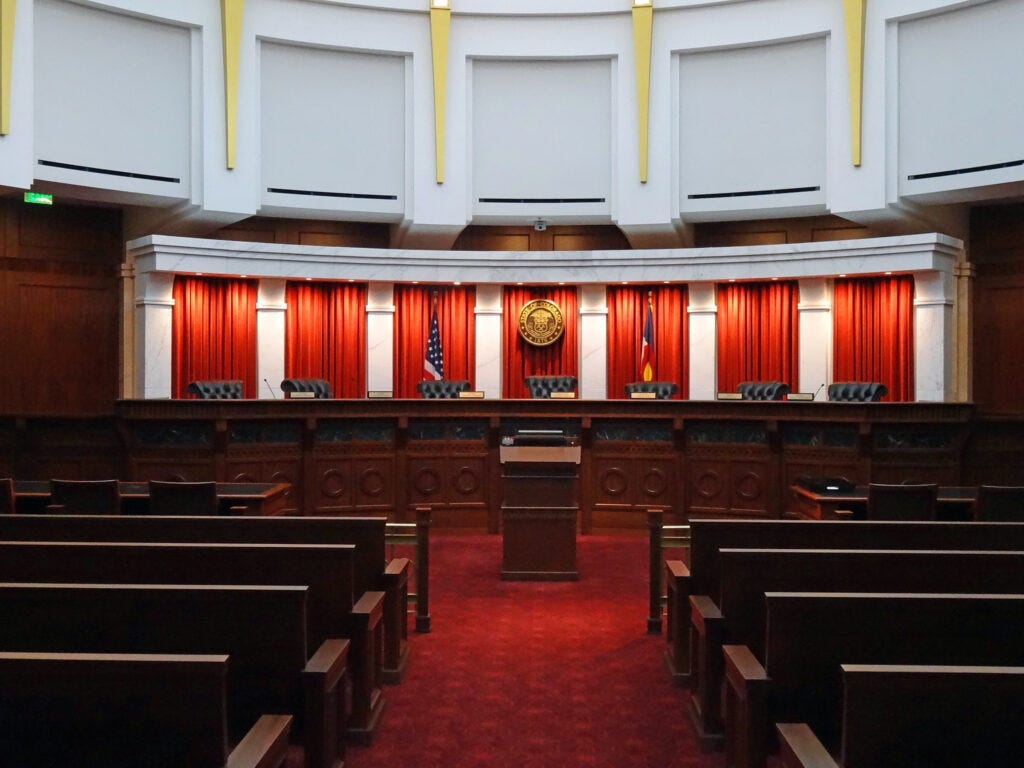
Today, the Colorado Supreme Court ordered Children’s Hospital Colorado to resume gender-affirming care for transgender youth, ruling 5-2 that the hospital discriminated against transgender youth patients when it shuttered its care program earlier this year in capitulation to Trump. The decision reverses a district court that had ruled against forcing the hospital to return to care and directs that court to issue a preliminary injunction restoring care while the case proceeds. Children’s Hospital Colorado was one of roughly 40 hospitals across the country that capitulated to Trump administration threats and ended their trans youth care programs. In its ruling, the state’s highest court held that the hospital’s fears of federal retaliation could not override Colorado’s civil rights protections for transgender people.
The case began in December, when Health and Human Services Secretary Robert F. Kennedy Jr. issued a declaration claiming that gender-affirming care for transgender youth was “neither safe nor effective” and warning that hospitals providing such care could be excluded from federal health care programs including Medicare and Medicaid. Children’s Hospital Colorado halted its program in January, and four transgender youth and their families sued under the Colorado Anti-Discrimination Act. A Denver district court judge found that the families would likely prove they had been discriminated against and that their children faced irreparable harm, but denied them relief anyway, reasoning that forcing the hospital to resume care could provoke catastrophic federal retaliation. As we reported in April, the families appealed directly to the Colorado Supreme Court. Meanwhile, the Kennedy declaration was blocked in court for several violations of law.
In Monday’s decision, the court rejected the hospital’s central defense: that it had not discriminated against transgender youth but had simply declined to offer one category of treatment. The justices found that distinction meaningless, noting that the hospital continued to provide the very same medications, puberty blockers and hormone therapy, to cisgender youth while denying them to transgender patients. “Even without analyzing the disparate treatment between transgender and cisgender youth, CHC’s policy to suspend providing medical gender-affirming care explicitly discriminates against patients because of their gender identity,” the court wrote. “Gender-affirming care is inextricably intertwined with gender identity,” ruling that ceasing providing care was discrimination against transgender people and therefore illegal under state law.
The majority was equally direct in rejecting the hospital’s argument that it had merely been following the Kennedy Declaration. “Although CHC acted reluctantly and expressed no animus toward transgender patients, the action it chose to take in response to the Kennedy Declaration specifically targeted transgender youth patients,” the court wrote. “The Kennedy Declaration may have influenced CHC’s decision, but it doesn’t absolve CHC of responsibility.”
The most consequential portion of the ruling addressed whether federal threats could be allowed to override state civil rights law. The district court had reasoned that ordering the hospital to resume care would compel it to violate federal law. The Colorado Supreme Court flatly rejected that framing. “The trial court’s concern about opposing the public interest by ordering CHC to ‘violat[e] . . . federal law’ is also misplaced,” the court wrote. “Why? Because the Kennedy Declaration isn’t federal law.” The justices also refused to weigh the harm to transgender youth against the broader hospital population in raw numerical terms, a comparison the district court had used to side with the hospital. “We conclude that a Trinidad-style strict numerical comparison of affected individuals isn’t appropriate when the individuals seeking injunctive relief are part of a protected class and seeking an injunction because of discrimination based on that protected class,” the majority wrote. “Were it otherwise, minority groups would always lose. But that is not the law. On the contrary, that’s precisely why we have protected classes.”
The court found that the actual harm to transgender youth far outweighed the hospital’s speculative fears, describing in stark terms what the loss of care had done to the plaintiffs. “Petitioners and other transgender youth who sought such care from CHC were suddenly abandoned during a precarious time,” the court wrote, noting that the children had “experienced depression, and in at least two instances, suicidal ideation.” The justices detailed the case of one plaintiff, Danielle Doe, whose family had moved from Texas to Colorado for its protections for transgender people. “After learning that CHC could no longer provide her care, Danielle was hospitalized at CHC for a depressive episode,” the ruling states. “She wrote her mother a letter that expressed suicidal ideation, stating, ‘If I don’t see you again, I love you.’” By contrast, the court found the hospital’s feared exclusion from federal programs “speculative,” noting that no exclusion could occur without notice, hearings, and opportunities for judicial review, and that a federal court in Oregon had since declared the Kennedy Declaration unlawful and barred HHS from enforcing it.
Two justices dissented. Justice Brian Boatright, joined by Justice Carlos Samour, argued that the hospital had acted not because of its patients’ gender identity but because it faced “the risk of losing hundreds of millions of dollars in federal funding, which would threaten the viability of its entire hospital system.” The majority was unpersuaded, holding that a “reluctant” act of discrimination compelled by a “third party” remains discrimination under Colorado law. With the decision, Children’s Hospital Colorado joins a growing number of hospitals, including Rady Children’s Hospital in San Diego and Children’s Minnesota, that have moved to restore gender-affirming care after initially halting it under federal pressure. The ruling also answers the question many public officials have been grappling with in terms of state anti-discrimination law: whether vague federal threats, unaccompanied by any law or court order, are enough to nullify a state’s civil rights protections. The Colorado Supreme Court’s answer was firmly: no.
A full copy of the ruling can be found here:

This is fantastic. I'm so grateful that CO will (hopefully!) remain a safe haven for trans minors.
The Colorado Supreme Court’s decision instructing Children’s Hospital to resume serving the transgender community sends a clear and necessary message: hospitals, clinics, and medical institutions cannot abandon vulnerable patients because of political pressure or manufactured outrage.
The court made clear it did not agree that Children’s Hospital had fairly treated transgender patients and found that transgender patients were in fact discriminated against when these services were cut off.
That is a powerful statement from the court and a warning to every healthcare institution in Colorado.
Gender-affirming care is recognized medical care supported by major medical organizations, and denying access puts lives and mental health at risk.
This ruling makes it clear that healthcare providers in Colorado must uphold their obligations to patients, not extremist politics.
Every hospital and clinic in Colorado should take notice and immediately restore these services without delay. The transgender community deserves dignity, evidence-based healthcare, and equal treatment under the law.
It also sends a message to other states that JFK Jr nor Trump can force these institutions to abandon this community.