

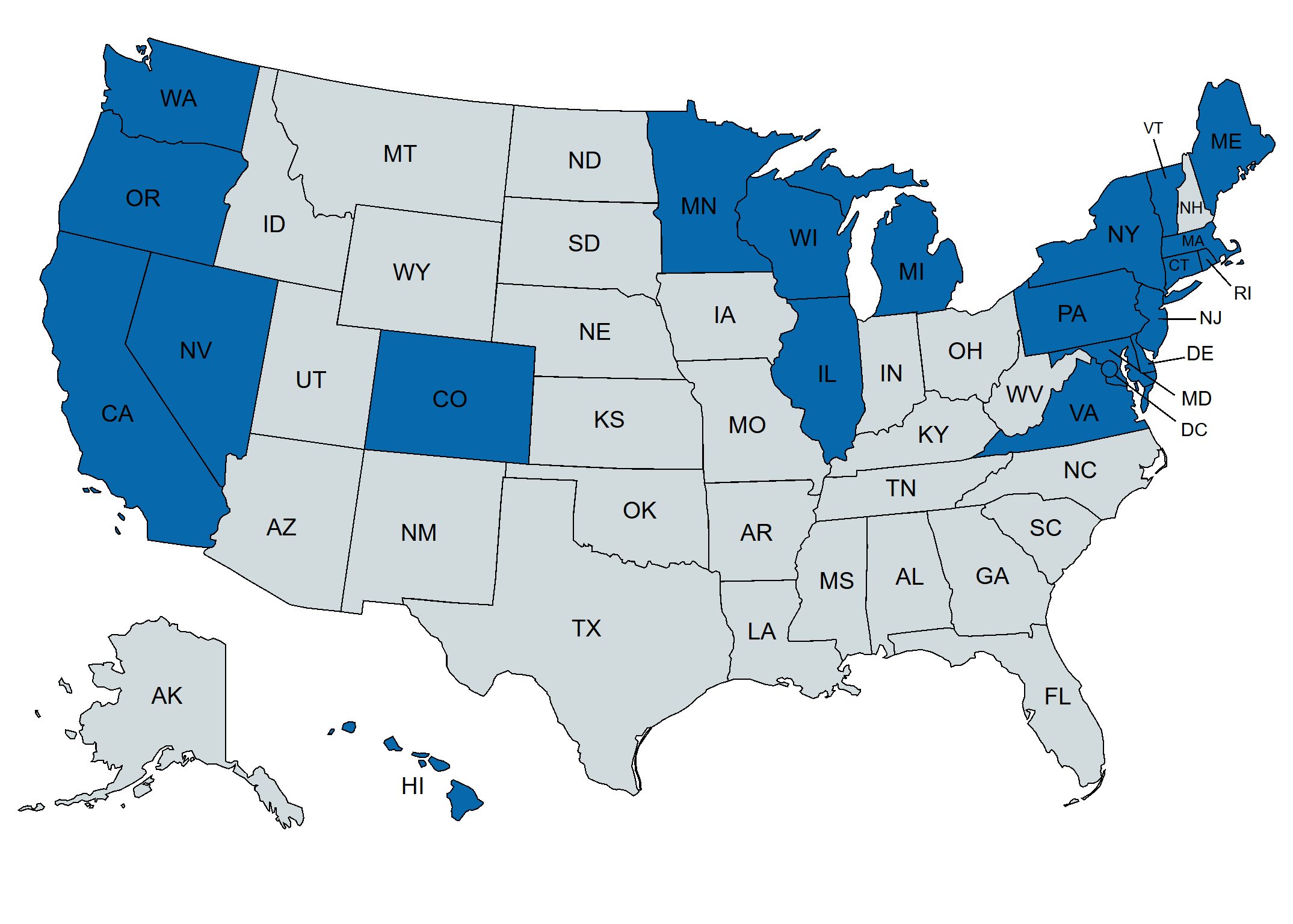
Six weeks before a new federal rule stripping Medicaid and CHIP funding for transgender healthcare is set to take effect nationwide, a coalition of 21 attorneys general and one governor has filed a lawsuit to block it. The coalition, co-led by California Attorney General Rob Bonta alongside the attorneys general of Illinois, Maryland, Connecticut, and Massachusetts, filed suit in the U.S. District Court for the District of Massachusetts. The lawsuit targets a rule published on Aug. 13 that bars federal reimbursement for puberty blockers, hormone therapy, and surgery for anyone under 18 on Medicaid or under 19 on CHIP, and which could do significant harm to transgender youth in these states, who currently have that care covered. The lawsuit follows an earlier successful suit that blocked the administration from threatening hospitals and doctors with exclusion from Medicare and Medicaid for providing that care. A companion rule that would have barred hospitals outright, through Medicare "conditions of participation," was never finalized, meaning no in-tact federal rule requires hospitals to stop providing gender-affirming care to transgender youth, though roughly 40 dropped their programs anyway and many have not restored them.
"The Administration seeks such broad and unprecedented powers in part to advance its social policy agenda, a key component of which involves relentless attacks on a small and vulnerable population—transgender individuals—whose very existence the President scapegoats to stoke national division,” reads the complaint. "Through this Rule, CMS sets a troubling and unlawful precedent that the Executive Branch can, without Congressional authorization, replace individualized medical judgments made by licensed practitioners consistent with state law with a categorical, agency-determined prohibition on federal reimbursement for healthcare it happens to disfavor, even where the care is widely supported by medical professionals and protected by law in many Plaintiff States."
The complaint alleges four violations by the federal government. The first is a violation of the Administrative Procedure Act, alleging that the law the government is relying on to strip coverage for gender-affirming care does not grant it the power to do so. Historically, the provisions CMS leans on, the Social Security Act's "best interests" and "quality of care" requirements, have imposed duties on states rather than granting the agency power to exclude entire categories of care. "Even CMS admits several times throughout the Rule that this is unprecedented action, acknowledging the agency has 'not previously relied on [the statutory provisions it relies on in the Rule] to establish a purpose-based restriction on FFP for a specific category of services in this manner,' nor 'historically taken a position at the Federal level that particular services when provided to particular individuals for a particular purpose are inherently not medically necessary,'" reads the filing.
The second alleged violation is that the rule is contrary to existing law. Under Medicaid's provisions, states must cover services deemed medically necessary for beneficiaries under 21, and CMS's own guidance requires that determination to be made "on a case-by-case basis, taking into account the particular needs of the child." Federal law also states that a state may not "arbitrarily deny or reduce the amount, duration, or scope of a required service...to an otherwise eligible beneficiary solely because of the diagnosis, type of illness, or condition." The rule singles out gender dysphoria as a condition, and CMS concedes such, acknowledging in the rule that it "limits FFP for specific pharmaceutical and surgical interventions for a specific population." The states also allege violations of the Medicaid Drug Rebate Program, CHIP, and the Affordable Care Act, all of which, the states argue, require coverage of this care.
The third alleged violation is that the new rule is arbitrary and capricious. The states argue that the Centers for Medicare & Medicaid Services held the evidence against its position to a far more demanding standard than the evidence it relied on, and that it acted contrary to the record before it. The administration leans on its own HHS report, the U.S. answer to Britain's Cass Review, to justify the ban, but the report is filled with language displaying clear animus toward transgender people, including misgendering one of the first transgender people in the United States to receive gender-affirming surgery, and was not written by experts in the field. Meanwhile, the administration issued the rule while ignoring the evidence that gender-affirming care is effective, including comment letters opposing it from the American Academy of Pediatrics, the American Medical Association, the American Psychiatric Association, and the Endocrine Society. In particular, the filing notes that the nine people who wrote the report had each previously published criticism of transgender healthcare while none had expertise in diagnosing or treating gender dysphoria, that they arrived at a conclusion Trump had predetermined by executive order, and that they operated as a federal advisory committee in violation of the law, with no charter filed or public meetings.
"One author, Alex Byrne, explained in detail in an op-ed that the HHS Report advocates for President Trump's policy of suppressing transgender healthcare for adolescents. Byrne states that after surveying the evidence the HHS Report 'found' the sought-after conclusion,” states the complaint.
Lastly, the lawsuit alleges a violation of the Spending Clause. When Congress created Medicaid in 1965, it gave states the authority to determine what care is medically necessary for their own residents, and CMS acknowledges in the rule itself that "the States have traditionally used their policy powers to regulate the practice of medicine." As such, the coalition argues the states retain authority over how Medicaid operates within their borders, including the ability to keep covering transgender healthcare.
The lawsuit is the next major step in the fight to protect transgender healthcare. Similar suits have already blocked other rules and threats, including the one that successfully blocked RFK Jr.'s declaration that gender-affirming care is "unsafe and ineffective" and fails to meet "professionally recognized standards of health care," which a federal judge vacated as unlawful. There is currently no active law, policy, or rule requiring hospitals to stop providing gender-affirming care to transgender youth, though more than 40 hospitals and health systems have stopped or paused their programs in capitulation to Trump.
The states leading the suit are California, Illinois, Maryland, Connecticut, and Massachusetts, joined by Colorado, Delaware, the District of Columbia, Hawai'i, Maine, Michigan, Minnesota, Nevada, New Jersey, New York, Oregon, Rhode Island, Vermont, Virginia, Washington, Wisconsin, and Pennsylvania Gov. Josh Shapiro, who is suing in his own official capacity because his state's attorney general is a Republican. It was filed in the U.S. District Court for the District of Massachusetts, the same court that vacated the administration's attempt to strip gender-affirming care of essential health benefit status three weeks ago.
It’s so encouraging to see these states fighting for what’s right rather than succumbing to the populism.
Fantastic! Glad to live in one of them. Thanks for the good news. This is the first I heard of it.