

Several protesters were dragged from the Pediatric Academic Societies (PAS) meeting’s conference hall this past Sunday in Boston. The crowd clapped as security hauled them off—in support of the activists disrupting the very event they were attending, hosted by the organization where most of them were ostensibly members.
The demonstrators sought to challenge the misleadingly-named panel entitled “A Scientific Dialogue on the Care of Transgender and Gender Diverse Youth,” an early morning event at one of the largest and most influential academic pediatric gatherings in the United States.
Erin in the Morning reported last week that all the speakers on stage for this particular workshop—the only one dedicated exclusively to trans care—were tied in one way or another to the Society for Evidence-based Gender Medicine (SEGM). Civil rights groups argue SEGM is plagued by seedy origins, pseudoscientific fanfare, and tireless anti-trans advocacy, fueling countless state and federal attacks on transgender people.
This is what motivated the activists who disrupted the event, and the independent efforts of other clinicians to either change or stop the PAS panel with SEGM affiliates altogether. “Trans liberation now!” one protester yelled as they were wrestled out of the door. “This is a hate group!”
Reports indicate the audience was visibly sparse for a convention with 7,000 attendees. Nonetheless, they overwhelmed the room with applause for the dissidence.
The demonstrators were wrestled into the hallway after only a minute or two. There, PAS clinicians were autonomously staging their own, separate action—redirecting attendees to evidence-based resources about trans health care, passing out pride flags, and distributing peer-reviewed literature critiquing the “Gender Dysphoria Report” commissioned by the Trump Administration—and co-authored by Dr. Moti Gorin, the Colorado State University bioethicist chairing that PAS panel.
Researchers published a scathing commentary on the report in the Journal of Adolescent Health, which was handed out to people passing by or entering the room. This paper found that the report contained “numerous violations of scientific norms” and “misrepresentation[s] of scientific evidence.”
“The [HHS] report is a dangerous example of government incursion into the provision of evidence-based medical care,” they concluded.
Health care workers at the conference told Erin in the Morning they were concerned that unwitting attendees wouldn’t know about SEGM’s hate group status, panelists’ ties to the wider anti-trans pseudoscience network, or ethical and methodological controversies surrounding their work. SEGM’s crowning achievement has arguably been its ability to artificially inflate doubt around trans people’s health care and market anti-trans propaganda as dispassionate clinical concern—which in turn manufactures legal grounds to restrict care.
A report published by the Southern Poverty Law Center said that “since its founding, members of SEGM have undertaken a global media and public policy blitz to challenge the affirming care model, advocate against gender-affirming care, and lend scientific credibility to legal claims against LGBTQ+ civil rights.” It also designates SEGM as an anti-LGBT hate group.(SEGM disputes this.)
Even more, medical professionals at the conference would be able to receive continuing medical education (CME) credits from the event, which are necessary for doctors to maintain their licensure. Last year, an Erin in the Morning investigation into SEGM’s CME content at Washington State University found its presentations were rampant with pseudoscience and political messaging. After people filed complaints and called its accrediting status into question, WSU removed SEGM content from its for-credit offerings.
This is why Dr. A Koyama, an Arizona-based pediatrician, approached the conference room doors with her own sign—”KNOW THE PANELISTS.” It was plastered with a QR code leading to Erin in the Morning’s investigation into the PAS speakers. When she saw other people passing out the papers, she joined that effort, too.
Even with a disruption or two the panel went on, save some light apparent sabotage; a QR code meant to submit questions to panelists was leaked online.
“I don’t feel that what happened on that day was a big organized event,” Koyama told Erin in the Morning in a phone interview. “It was more like, one or two friends saying, ‘I’m going to do this,’ or ‘I’ll bring that.’ People just coming together by themselves.”
It was around this time security guards asked her to leave because of her sign. She obliged, which is when she encountered a couple dozen protesters on the sidewalk—a brass band, a team of trans youth, and a cadre of allies and supportive health care providers. They were picketing the event and handing out fliers to warn attendees about SEGM’s history of anti-trans activism. The youth canvassing on the outside had no idea that these doctors on the inside were organizing, too.
Koyama stepped up to the mic to join the trans youth on the pavement. “I am proud to have been kicked out of PAS for our sign,” she declared.
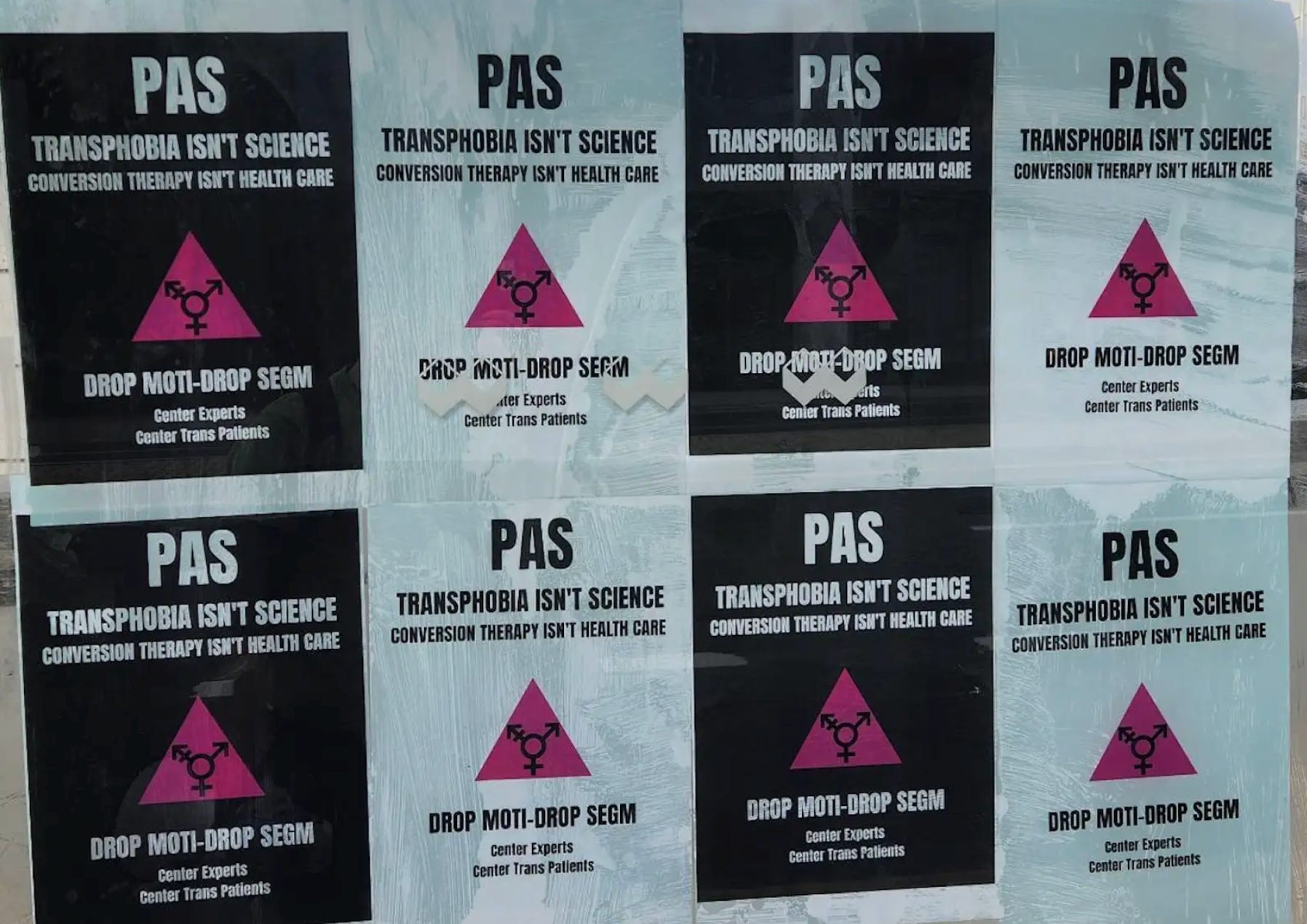
Meanwhile, posters were spotted around the convention center’s perimeter reading: “Transphobia isn’t science. Conversion therapy isn’t health care.” (This was ostensibly a nod to “gender exploratory therapy,” sometimes also marketed as “Cass-informed therapy,” which deploys conversion tactics condemned by human rights groups and experts.)
Protect Trans Futures, a grassroots direct action group led by young, transgender Bostonians, led the sidewalk protest. “We are the ones that have benefitted from the evidence-based medicine that’s come about,” Teddy Walker, PTF’s co-founder, told Erin in the Morning. “We are the ones that have been able to start our transitions as minors, and that has saved our lives.”
The 21-year-old organizer said that over the span of hours, the modest group engaged in dialogue with hundreds of medical professionals, handing out upwards of 800 flyers about the event. “Every provider we talked to was shocked and outraged once they heard what was happening,” Walker said.
Protect Trans Futures also organized an email-petition campaign that sent messages to around two dozen PAS leaders and sponsors for every signatory, resulting in over 90,000 emails sent by the time they capped the drive on Monday. The goal: Convince PAS to drop Dr. Moti Gorin and cancel the panel, or at least strike its eligibility for CME credits.
Although PAS is hosting the event, the CME credits had to be approved by the Baylor College of Medicine, a partner institution, which said it reviewed the panel for compliance ahead of time.
After the panel, the Pediatric Endocrine Society also came out in opposition to the event. “Prior to and during the meeting, we had been in communication with some of PAS leadership about our serious concerns” it said in an email to members.
“While the description advertised the session as a scholarly review, the panel was made up entirely of individuals who have espoused views that run counter to the bulk of the primary literature and the advice around care provided by the vast majority of major medical associations. While PES welcomes different points of view, we believe that presentations at conferences should be as evidence-based as possible.”
Neither PAS leadership nor Gorin responded to a request for comment for this follow-up. The other panelists—Dr. Riittakerttu Kaltiala, Dr. Anna Hutchinson, and Dr. Steven Montante—did not respond to initial requests for comment for Erin in the Morning’s reporting on the matter.
In response to internal backlash ahead of the event, PAS Program Chair and Q&A moderator Dr. Daniel Rauch, of the Hackensack Meridian School of Medicine in New Jersey, told the audience that PAS had tried to recruit an affirming gender care provider, but those they asked declined to participate. It is not clear who they asked, how many providers they asked, when they asked or why they turned PAS down. He also said he added resource links to gender-affirming literature to provide additional perspectives.
Meanwhile, in a prior interview with Erin in the Morning, Gorin rejected characterizations that SEGM or the Trump-ordered report he worked on might contain hateful or pseudoscientific rhetoric. He said he picked a cohort for the panel that was approved by PAS; one he felt was diverse. He tapped into clinicians from different countries, different areas of medicine, and people who may not “agree on everything.” He had hoped that detractors would attend the panel and engage with the speakers.
But unlike other conference sessions, the PAS moderator didn’t even give the audience a chance to hold the microphone to directly address them.
Walker, meanwhile, said the events of the day were nonetheless “a huge win” for their organizing to spread awareness of anti-trans actors and narratives.
“Everyone told us: ‘We are with you. This panel does not represent our views. We don’t understand how this was allowed to happen.’”

I just want to pause to express my gratitude and admiration for what Erin and S have managed to do. Decades ago, I used to do much more limited coverage of trans issues for some obscure publications. Our numbers were miniscule back then. It was hard for us to rally very effective actions.
Since then, our numbers have been steadily growing, as more of us have stepped out of the closet. However, before Erin came along, coverage of trans issues was spotty at best. I paid a lot of attention to the news, and I would sometimes come across obscure articles from unlikely sources that should have gotten much more attention than they did. Indeed, most trans people weren't even aware of some developments with potentially terrifying implications for them.
Then came Erin and S. Together, they have managed to scoop up most of the important news that impacts us and to let us know about it. Moreover, they have established such a broad influence and readership that we have amassed some real power for once. I'm still gobsmacked that EITM was able to sound the alarm and precipitate such a wide response - with 100,000 emails eventually going out! I mean, that's jaw-dropping.
Not only do we have more power now, through greater knowledge, but I think many of us might say we have more peace of mind. At least I would say that. I no longer have to worry that I might be missing some important item of news that could mess up my life. I can honestly say that I think EITM has my back. I sleep better at night, just feeling as though I know what's going on - good or bad.
Anyway, I just want to say "thanks." I'm impressed with what you have put together, and I am also impressed with what WE can sometimes accomplish with the good information you give us.
Thank you Baum.
I am very, very happy to hear the pushback went somewhere besides a circular file.
~for the dissidents~ Dissidence is a probable typo?