

One defining feature of the modern anti-transgender panic has been the fixation on bathrooms. While early efforts in 2016 were widely rebuked and ultimately failed, the last four years have seen several states enact new versions of bathroom bans. Most have targeted public schools, but legislators have increasingly pushed further—extending restrictions to colleges and universities, publicly owned buildings, even airports. Now, New Hampshire Republican lawmakers are taking the cruelty a step further: their latest proposal would apply to private businesses that offer public restrooms, turning the simple act of a transgender person using the bathroom into potential “willful trespass.”
The bill, HB1442, at first glance resembles measures enacted in states like Texas, South Dakota, and Wyoming. It bars transgender people from using bathrooms that match their gender identity in government-run buildings, including prisons, schools, and municipal facilities such as public restrooms and highway rest stops. But where most states enforce these laws through civil penalties against the government institutions themselves—allowing cities or schools to be sued—New Hampshire’s proposal goes further by targeting the transgender person themselves. It creates a separate trespass statute tied specifically to bathroom use, mirroring Florida’s approach, which likewise imposes criminal penalties on transgender people for entering the “wrong” bathroom.
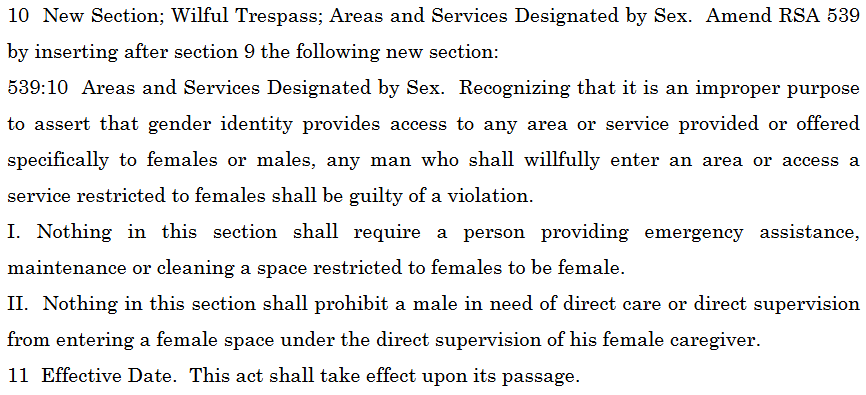
Importantly, the new violation applies only to transgender women—not transgender men. In debates over restroom access, Republicans have often grown visibly uncomfortable when confronted with the reality that many trans men present with traditionally masculine features, including beards and attire; trans men have repeatedly pointed out in hearings that forcing them into women’s restrooms would be both unsafe and absurd. Rather than take that point as evidence of the incoherence of bathroom bans, New Hampshire lawmakers appear to have drawn a different conclusion: they carved transgender men out of the “willful trespass” provision entirely, which appears to only apply to transgender women:
See the section here:
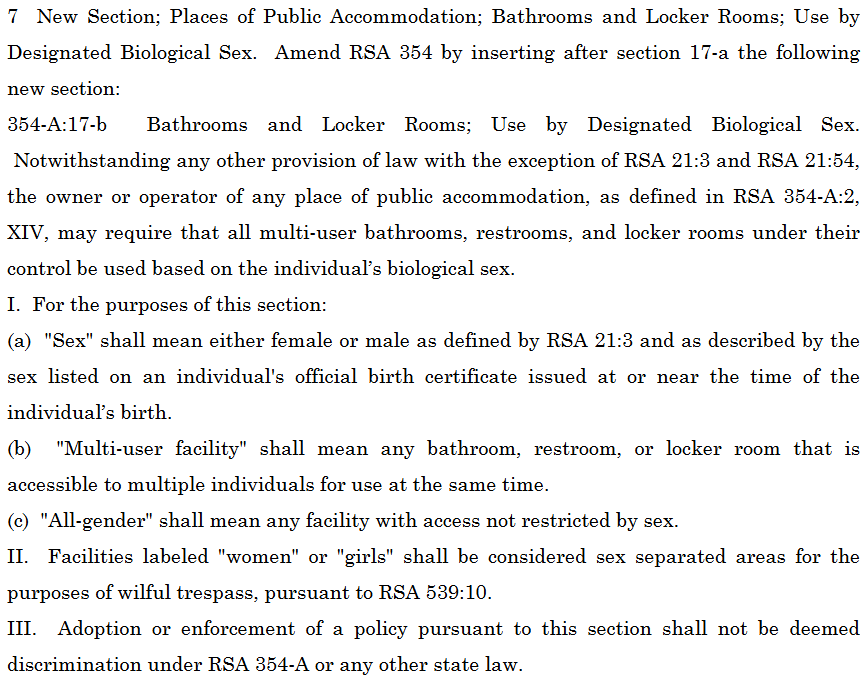
The new bill also targets transgender people in a way not yet seen in any other state: it applies to private businesses. While previous bathroom bans have generally stopped at public schools or government buildings, HB1442 extends its reach to any “place of public accommodation”—hotels, bars, theaters, concert venues, retail stores, and more—allowing those businesses to pursue willful trespass charges against anyone who enters the “wrong” restroom. The bill does not require businesses to file charges, but it does say that signage is sufficient grounds for doing so. In practice, that means transgender people would have to guess, bathroom by bathroom, which businesses might enforce the law—and risk a trespass charge every time they use a public restroom anywhere in the state.
See the section here:
The bill is backed by thirteen cosponsors, including several with significant leadership roles, such as Sen. Kevin Avard, who chaired the Senate Rules Committee in the 2023–24 session, and Sen. Regina Birdsell, who led the Senate Health and Human Services Committee during the same period. Their support does not guarantee the bill’s passage, but it is telling: multiple lawmakers with real influence inside the Republican caucus are choosing to elevate this proposal as a priority for the year.
New Hampshire has seen a sharp escalation in anti-transgender policymaking in recent years. In 2024, the legislature advanced both a school bathroom ban and a ban on trans-related surgeries for youth—measures that passed only because multiple Democrats crossed party lines to support them, the only state to see significant defections on transgender rights among Democrats. Those same Democrats pitched their votes as an appeal to “moderate” voters, yet the party went on to lose several seats that fall as Republicans expanded their control of the state. In 2025, lawmakers doubled down, approving additional bills targeting transgender students and prohibiting gender-affirming care for trans youth. New Hampshire has become a case study rebutting the idea that surrendering on transgender rights slows Republican attacks or protects Democrats politically; neither claim has been borne out.
As the 2025–2026 legislative season begins, New Hampshire now has twelve bills trained on transgender residents—an outlier in a region where most states are expanding civil rights, not dismantling them. It signals yet another year in which LGBTQ+ people and their allies will be dragged back into the same exhausting trench warfare, forced to defend the basic ability to move through public life without fear. The relentlessness of these attacks makes one thing unmistakably clear: the fight is not letting up, and neither can they.
Imagine if our state and federal governments put as much effort into fixing real problems as they do into screwing over trans people. What a world that could be.
Surely this is plainly unconstitutional, even by the current SC's jurisprudence. It plainly treats people differently according to sex, no matter how those troglodytes want to define it.