

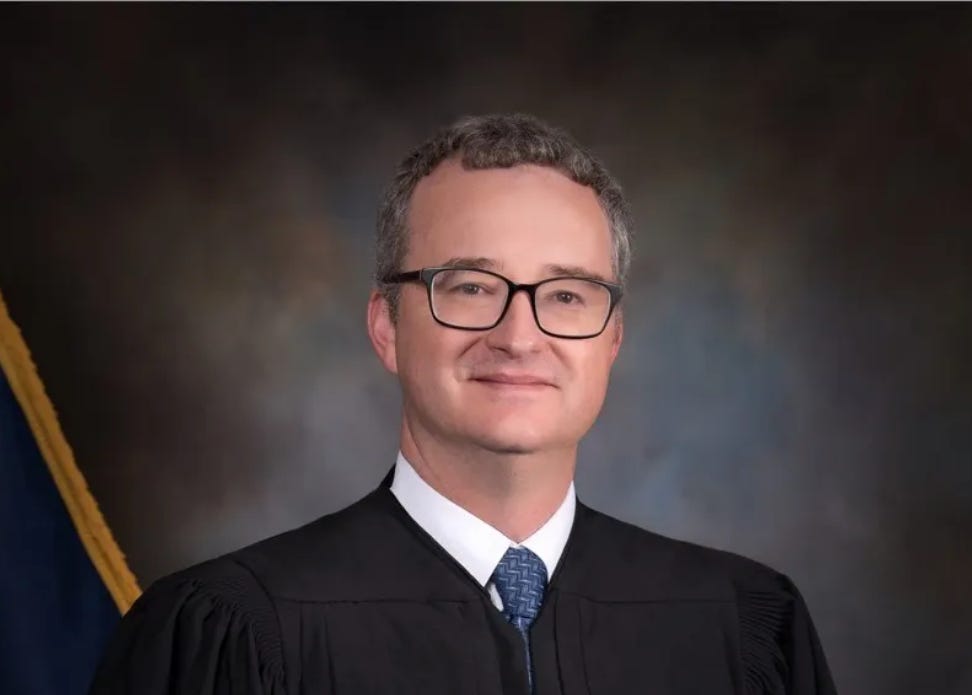
This weekend, a Kansas judge issued a scathing 117-page rebuke of the state's ban on gender-affirming care for transgender youth—and in doing so, methodically dismantled the case against that care. In his ruling, Judge Carl Folsom III worked through the testimony of the state's witnesses one by one, finding that its anti-transgender “experts”—routinely paraded by groups like the Alliance Defending Freedom, SEGM, and Genspect—offered opinions built on "cherry-picked information, conjecture, and research taken out of context," and granting their testimony little to no weight. He then laid out 349 individual findings of fact, drawn from scientific evidence and the testimony of credible medical experts, documenting the safety and efficacy of gender-affirming care. He ultimately found that the ban likely violates the Kansas Constitution—which guarantees broader protections than its federal counterpart. That distinction matters enormously: because the ruling rests on state constitutional grounds, it is largely insulated from the U.S. Supreme Court and its decision in Skrmetti, which closed the federal courthouse door to these challenges but left the state one wide open.
"Allowing a transgender adolescent with gender dysphoria to experience their endogenous puberty when puberty blockers are medically indicated according to the Endocrine Society Clinical Practice Guideline is highly likely to result in irreversible physical changes that create enormous short- and long-term distress and gender dysphoria," Folsom wrote. "Thus, there was substantial evidence that S.B. 63 not only fails to protect minors, but also endangers them, by prohibiting the use of GnRH agonists when medically indicated."
Before weighing the evidence, the judge first had to determine who could credibly be considered an expert. Republican Attorney General Kris Kobach brought forward a litany of anti-trans witnesses familiar from litigation defending these bans. Among them was James Cantor, a Toronto psychologist who has built a career testifying for states defending care bans despite no clinical experience treating transgender minors—and who was once quietly dropped from a Florida Board of Medicine hearing after it emerged he had served on the advisory council of the Prostasia Foundation, a group that has worked to destigmatize pedophilia. Folsom wrote that Cantor "has not conducted any original scientific research on the efficacy or safety of gender dysphoria treatments," and noted he is not licensed to treat anyone under 16 and has never diagnosed a minor with gender dysphoria. The judge then catalogued a record of self-contradiction: Cantor "stated that 'peer-review is the line between acceptable and not' but himself relied on non-peer reviewed sources," cited systematic reviews while ignoring that "the authors of those reviews stated that their work should not be used to prevent the provision of gender-affirming medical care," and "makes several statements which have no scientific support," including that gender dysphoria might be a misdiagnosis of borderline personality disorder. "The Court gives Dr. Cantor's testimony little weight," Folsom concluded.
The judge turned next to Farr Curlin, a Duke University doctor and theologian who was an author of the Trump administration's HHS report on pediatric gender dysphoria—a document authored anonymously by a roster of hate-group affiliates and career anti-trans activists, and which deadnames Christine Jorgensen, one of the first Americans to get gender affirming surgery. Curlin, Folsom noted, "is not a pediatrician, nor is he a psychiatrist or endocrinologist," and "has never treated anyone for gender dysphoria." Curlin testified that gender-affirming care is "ethically problematic"—but under questioning, the breadth of what Curlin considers unethical became clear. He believes that prescribing birth control for contraception is also "ethically problematic," because "blocking the capacity for reproduction seems contrary to the purposes of health." He believes in vitro fertilization is "ethically problematic" as well. He testified that when gender-affirming care reduces fertility, it "prevents the realization of the basic good of marriage, since sexual capacities make possible the one flesh union of marriage." By his own admission, Folsom noted, Curlin's views are "radically counter to current medical orthodoxy." The judge found his opinions "appear motivated by his personal views as opposed to a methodology applicable in the field of medical ethics," and gave his testimony "little-to-no weight."
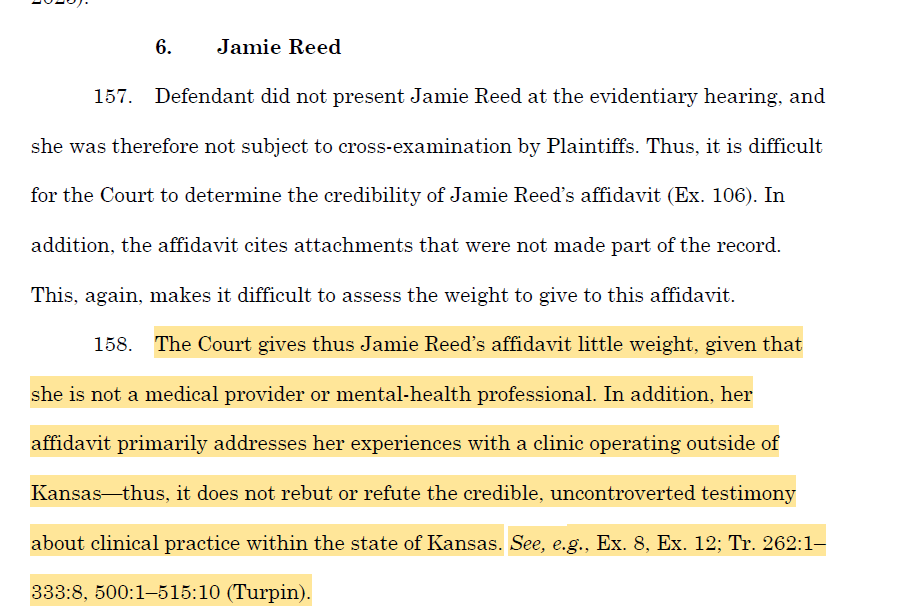
The judge also had pointed words for the state's roster of prominent anti-trans activists. Chloe Cole, the country’s most prominent anti-trans detransitioner, testified about receiving care as a minor in California—but Folsom noted that Cole "admittedly did not receive care in Kansas," and that the plaintiffs' expert Dr. Angela Turpin testified the care Cole described "would not have occurred in Kansas" and would have been inconsistent with the clinical guidelines Kansas providers actually follow. Her testimony was given "less weight." Corinna Cohn, another anti-trans detransitioner who has testified for care bans across the country and who has publicly denied that transgender people existed before 1939 or were victims of the Holocaust, did not appear at the hearing at all. The judge noted that Cohn's affidavit described "care accessed as an adult" and treatment "in Wisconsin"—nothing to do with minors, or with Kansas—and gave it "little weight." And then there was Jamie Reed, the self-styled "whistleblower" who built a national profile on lurid, largely unsubstantiated accusations against a St. Louis gender clinic and who has gone on Fox News to describe being transgender as a delusion. Reed also did not testify and could not be cross-examined. Folsom gave her affidavit "little weight,” and had scathing remarks towards her lack of expertise:
“The Court gives thus Jamie Reed’s affidavit little weight, given that she is not a medical provider or mental-health professional. In addition, her affidavit primarily addresses her experiences with a clinic operating outside of Kansas—thus, it does not rebut or refute the credible, uncontroverted testimony about clinical practice within the state of Kansas,” read the order.
Folsom then turned to set the record straight on the care banned by Kansas. Working through the testimony of the credible medical experts, he set out 349 separate numbered findings of fact, each documenting some component of what the science actually shows about gender-affirming care. Among them: that "the currently available body of medical research, as a whole, shows that gender-affirming medical care is effective at improving mental-health outcomes for adolescents with gender dysphoria," supported by "over 20 scientific studies" finding the treatments "effective at alleviating gender dysphoria and improving a variety of mental-health outcomes, including anxiety, depression, and suicidality." Folsom found that "for many adolescents, gender-affirming medical care provides significant relief from gender dysphoria and decreases depression, anxiety, suicidality, and thoughts of self-harm." On the question of regret, the talking point most relied upon by the law's defenders, the court found, based on the Kansas clinic's own long-term follow-up data, that 99.2% of patients who received gender-affirming care "continue to identify as transgender into adulthood," and that of the remaining 0.8%, "most did not regret the medical treatment they received."
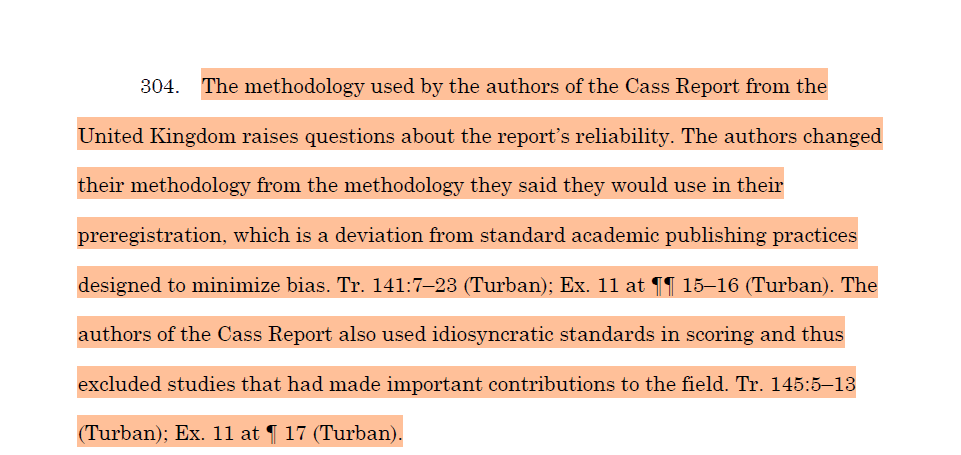
Folsom reserved some of his sharpest fact-finding for the Cass Review and claims over European care. The state's experts pointed to systematic reviews from the United Kingdom, Sweden, Finland, Germany, and Norway as “proof” the science had turned. Folsom found otherwise. "None of these systematic reviews recommend categorically banning gender-affirming medical care for adolescents," he wrote, and "the United Kingdom, Sweden, Finland, Germany, and Norway have not categorically prohibited gender-affirming medical care for minors"—as Kansas had. On the Cass Review specifically, Folsom found that its authors "changed their methodology from the methodology they said they would use in their preregistration, which is a deviation from standard academic publishing practices designed to minimize bias," and "used idiosyncratic standards in scoring and thus excluded studies that had made important contributions to the field." Far from recommending a ban, the court found, the Cass Report "reaches conclusions that are similar to those in the Endocrine Society Guideline and WPATH Standards of Care" and "concludes that there are young people who absolutely benefit from gender-affirming care." On Germany, the state had the facts backwards: Folsom found that "Germany's recent guideline endorses the provision of gender-affirming medical care"—a reference to the 2025 guidelines from 26 medical organizations across Germany, Austria, and Switzerland, the largest European medical consensus on transgender youth care ever produced.
The judge's ruling rested on the Kansas constitution. Folsom found the plaintiffs likely to succeed on the claim that SB 63 violates the fundamental right of parents, guaranteed by Section 1 of the Kansas Constitution Bill of Rights, to make medical decisions for their children. Section 1, he wrote, quoting the Kansas Supreme Court, "protects the core right of personal autonomy—which includes the ability to control one's own body, to assert bodily integrity, and to exercise self-determination" and "allows Kansans to make their own decisions regarding their bodies, their health, their family formation, and their family life." Because SB 63 strips parents of that right, Folsom applied strict scrutiny, the most demanding standard in constitutional law, and found the state had failed to meet it. That reasoning was used recently before in Kansas politics for another issue. The same Section is what protects abortion rights in the state. In previous abortion-related decisions, the Kansas Supreme Court held that Section 1 secures "an inalienable natural right of personal autonomy"—language the court used to strike down abortion restrictions, and that Kansas voters chose to keep in 2022 when they rejected a constitutional amendment that would have stripped it away.
For now, gender-affirming care is legal again in Kansas. The injunction is temporary, blocking SB 63 while the case is litigated, and Attorney General Kris Kobach has said he will appeal, calling the ruling "a stark example of judicial activism." But the appeal faces a structural problem. Because the decision rests entirely on the Kansas Constitution, the U.S. Supreme Court and its ruling in Skrmetti have no power to disturb it—a state's highest court is the final word on its own constitution. And the Kansas Supreme Court, where the case is ultimately likely to land, has five of seven justices appointed by Democratic governors and has repeatedly upheld the same Section 1 personal-autonomy right that Folsom relied on here.
I especially appreciate the judge (different judge) who called the gender critical to be, "obvious charlatans".
It is that the Social Conservatives have no possible case at all, that more than anything but the harm they do, justifies their prosecution under U.S.C. § 1983, 18 U.S.C. § 241, & 18 U.S.C. § 242 for their engineering, funding, and carrying out the propaganda campaign and enacting the laws and policies against transgender people.
Thank you Erin.
"Judicial activism!" cry the Republicans whenever a judge rules against them. Yet when SCOTUS literally gutted Section 2 of the Voting Rights Act they immediately set to erasing Black voting districts from their states.
So "Judicial activism" is obviously fine whenever THEY benefit from it because they are nothing but the biggest fucking hypocrites on the planet.