

Confusion, dread, and betrayal—these are the emotions flooding trans patients at the Vanderbilt University Medical Center in Nashville, Tennessee, as their health care options wane once again.
“Due to operational limitations and lack of surgical coverage, Vanderbilt Health will cease providing gender-affirming plastic surgeries for adults,” VUMC told Nashville Scene last week in a statement, which was also sent to Erin in the Morning and other outlets. “Vanderbilt Health continues to provide nonsurgical gender-affirming care for adults 19 years and older.”
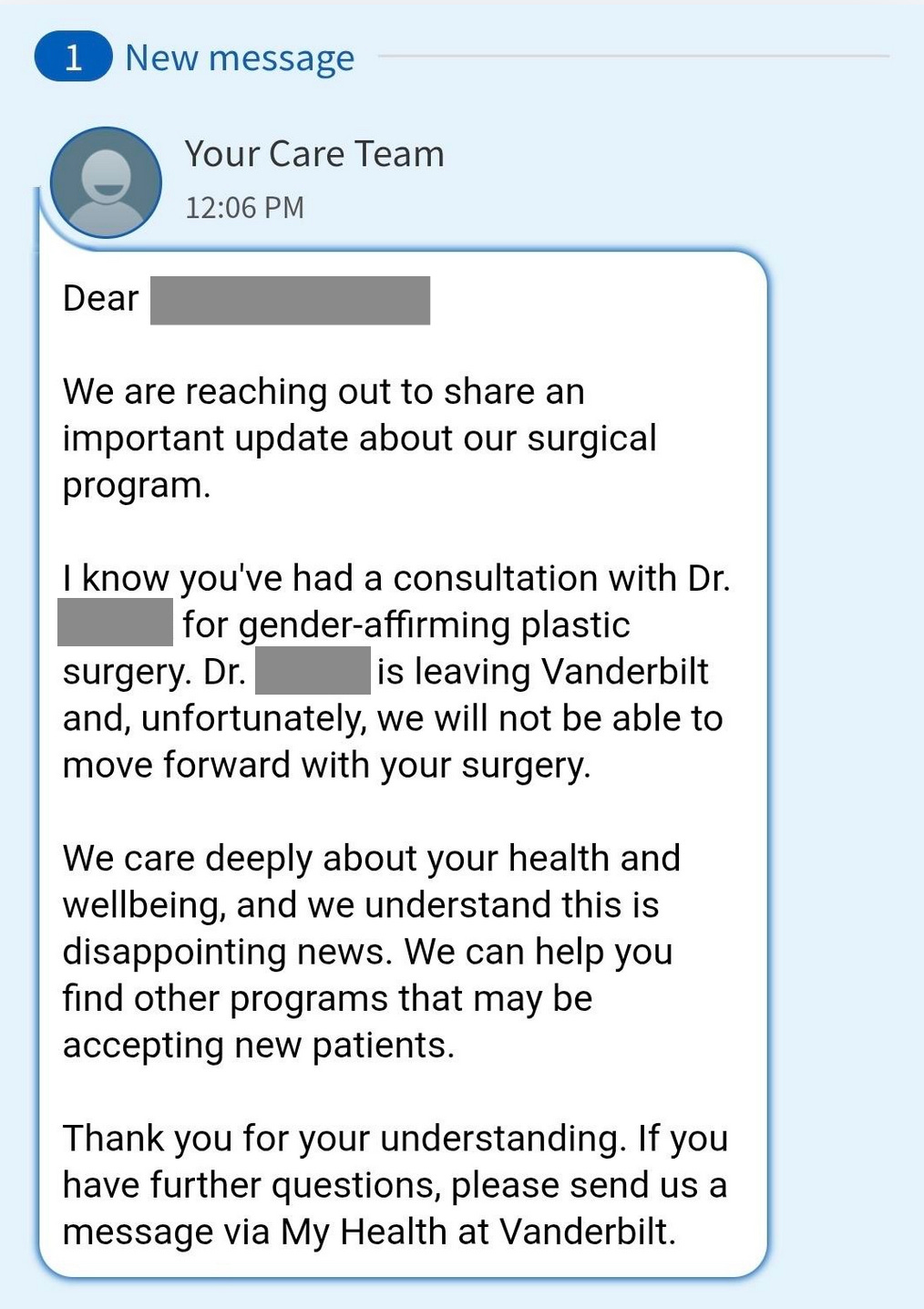
Meanwhile, patients started receiving updates via their medical portals, which cited the departure of the senior surgeon responsible for gender-affirming plastic surgeries.
However, Vanderbilt refused to provide more specifics when asked by Erin in the Morning.
The vague declaration has left many patients with more questions than answers. Is the doctor leaving due to the hostile political environment? Will Vanderbilt seek out another doctor who specializes in gender-affirming care as a replacement? And perhaps most pressingly, what does “gender-affirming” plastic surgery mean in this context?
Whereas some procedures are highly specialized—like phalloplasties and vaginoplasties, which are part of a series of procedures colloquially known as kinds of “bottom surgery”—the phrase “gender-affirming” plastic surgeries can also include rhinoplasties, breast augmentation, and mastectomies, all of which are also commonly sought by cisgender people.
Presumably, this means that other doctors in the plastic surgery unit would at least have the know-how to provide this care. But VUMC would not tell Erin in the Morning whether trans people will be barred from these procedures, even as cisgender people’s access to such treatment evidently remains uninhibited.
At least two sources close to the matter told Erin in the Morning that the care will sunset over a period of six months, and that some patients may be referred to the closest nearby hospitals that perform “bottom surgeries” for trans people. But those hospitals are hundreds of miles away.
One trans Tennesseean, Marie, first found out her vaginoplasty surgeon would be leaving Vanderbilt via a community group chat, and then, through news headlines. (Marie asked that her full name be withheld due to privacy and safety concerns.)
It was only after reaching out to VUMC that she received a message in her patient portal—a pattern seen across the country, where hospital gender care rollbacks have often been haphazardly announced through terse press releases from nameless hospital bureaucrats.
Marie, a Nashville area mom, said if she indeed needs to go to another hospital across state lines, she will functionally have to move to another city, potentially for months, so that she can remain close to her surgeon for her post-operative follow-up appointments and care.
“This isn’t the first time we’ve felt like Vanderbilt has sold out our community,” Marie told Erin in the Morning.
It’s been well-reported that many doctors are undergoing a mass exodus from anti-trans, anti-science red states; such policies actively drive away top talent. But Vanderbilt, especially, has been lambasted by LGBTQ advocates and lawmakers for failing to protect its patients and providers.
“The Mid-South is such a health desert for this type of care,” said Dahron Johnson, an activist and hospice chaplain who formerly chaired VUMC’s LGBTQ Community Advisory Board. For a spell, the care it provided to the region was groundbreaking.
“Providers who came based on that energy and intentionality find themselves without good communication and without good support, much like a lot of patients have felt,” Johnson told Erin in the Morning. VUMC, meanwhile, “has ended up making a lot of decisions behind the scenes that have caught both patients and providers off guard.”
A July 2025 letter from the municipal government’s LGBTQ Caucus issued a vote of no confidence against VUMC leadership and blocked a partnership between the Metro Health Department and Vanderbilt. “Despite once claiming to lead in LGBTQ+ healthcare, VUMC has shown a sustained pattern of retreat and betrayal,” Councilmember Emily Benedict added on Instagram.
In 2022, VUMC paused gender-affirming surgeries for minors due to political pressure. In 2023, it willingly released confidential, unredacted patient records to hostile state authorities, a matter which is subject to ongoing litigation. And in 2025, it quietly laid off its LGBTQ+ outreach staff and withdrew its support from Nashville Pride.
Moreover, Tennessee was at the center of the Supreme Court’s Skrmetti decision last year, which determined that the state’s law prohibiting certain medical treatments for transgender minors was not unconstitutional under the Equal Protection Clause of the Fourteenth Amendment.
The current chair of VUMC LGBTQ advisory board—who asked not to be publicly named due to fears of public retaliation and anti-trans violence—said it’s never been easy being trans in the South, but that the constant state of precarity has also bred resilience. It has meant that, even before Trump’s grand return to the Oval Office, queer Southerners have been building networks of care that so-called “safe” blue states can learn from.
“We’re used to having to fight a lot for our rights, for our healthcare, and just to be recognized,” the chair told Erin in the Morning. “The survival of all trans folks depends upon the survival of trans folks in the South.”
“They’re going to come after the South first, make sure that their tactics work,” he continued. “Then they’re going to push them out to other states. That’s what we continue to see.”

As a girl who's own surgery date is rapidly approaching, this is the kinda crap I fear the most. My heart goes out to those who were scheduled and lost their appointment. It must be soul crushing, and we deserve better.
When I read "We care deeply about your health and wellbeing, and we understand this is disappointing news." my anger hit. Then sadness for everyone.