

On Monday night, the U.S. Supreme Court issued a shadow docket decision that reinstates a lower court judge's injunction in favor of parents who wish for the forcible outing of transgender children in California and who wish for their transgender children to be misgendered by their teachers. The decision is the latest in a series of anti-transgender decisions by the Supreme Court, with more potentially on the way soon. The full impact of this decision is not yet clear, though it is likely going to lead to the invalidation of California's prohibition on forced outing and could be used to challenge individual school policies nationwide—even potentially leading to the forced misgendering of transgender youth in safe states. Because of a provision in the lower court injunction that prohibits schools from using different names or pronouns with parents than are being used at school, all parent contact effectively becomes an outing event for transgender students across California.
“Gender dysphoria is a condition that has an important bearing on a child’s mental health, but when a child exhibits symptoms of gender dysphoria at school, California’s policies conceal that information from parents and facilitate a degree of gender transitioning during school hours. These policies likely violate parents’ rights to direct the upbringing and education of their children,” says the unsigned majority opinion, leaning heavily on a parental rights framework to rule in favor of the forced outing of transgender youth.
The use of the parental rights framework is something that the liberal minority of the court did not pull punches on. In a footnote to her dissent, Kagan writes, "Another contrast—this time, between this case and United States v. Skrmetti—is also striking. In Skrmetti, several parents challenged Tennessee's ban on gender-affirming care for minors. The suit raised claims grounded in both equal protection and substantive due process. As to the latter, the parents in Skrmetti, similarly to the parents here, asserted a right 'to make decisions concerning medical care for their minor children.' And in support of that right, the Skrmetti parents relied on the same precedents the Court does today. But the Court, when deciding to grant certiorari in Skrmetti, limited its review to the equal protection issue: It would not even hear the parents out on their substantive due process claim."
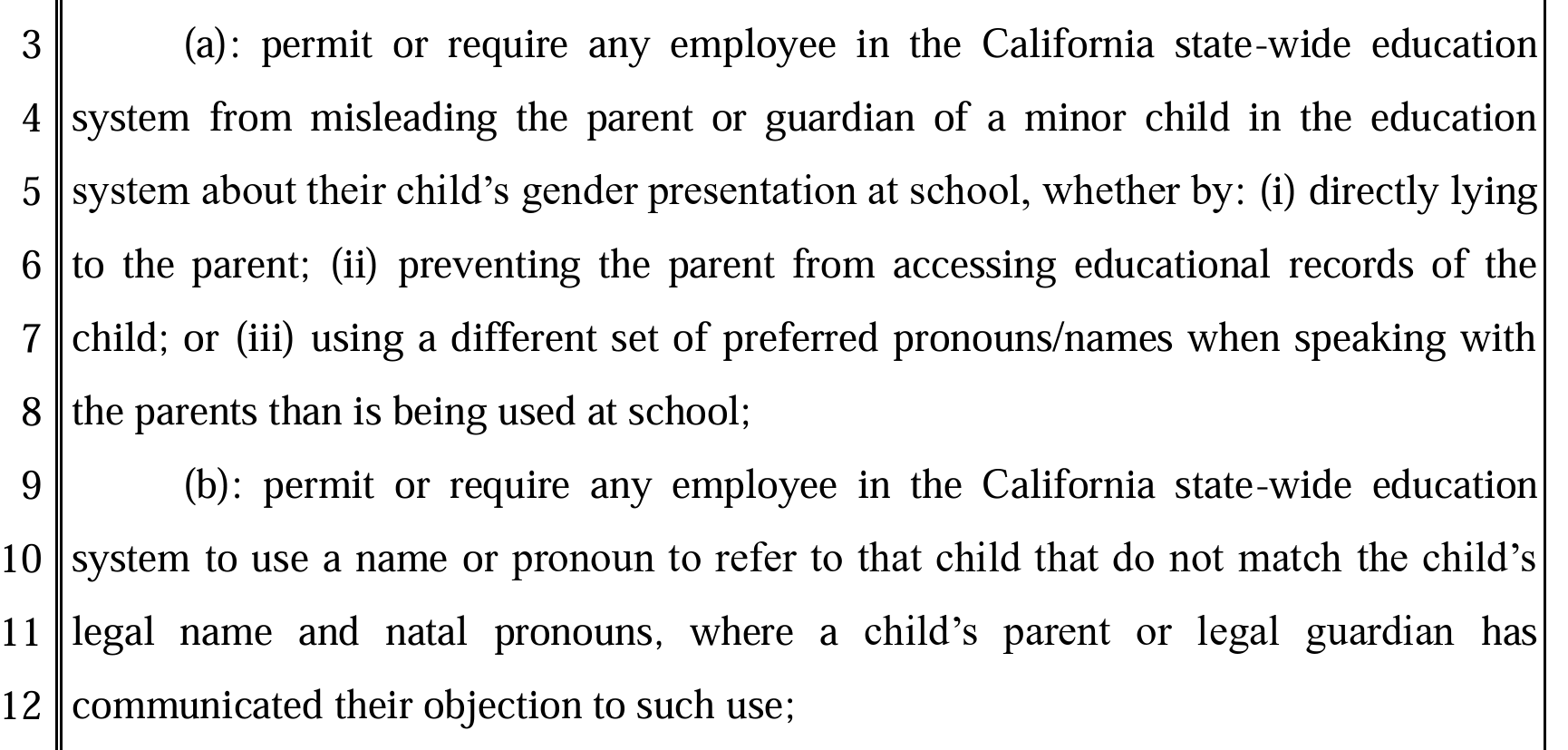
The ruling is a response to a lower court injunction issued in December by U.S. District Judge Roger Benitez in a case that has been working through the courts since 2023. While the case predates California's SAFETY Act—a 2024 law that prohibits school districts from adopting forced outing policies—the reasoning in both the district court ruling and the Supreme Court's decision effectively undermines the law's protections. The district court injunction prohibits schools from using a different name or set of pronouns with parents than they use with the student at school. In practice, this means a transgender student must consent to being deadnamed and misgendered in class if they want to maintain any privacy from their parents. This injunction is now back in effect.
While the ruling technically applies only to California, the constitutional reasoning extends far beyond the state’s borders. The court’s due process holding—that parents have a right “not to be shut out of participation in decisions regarding their children’s mental health”—applies to all parents, not just those with religious objections. That means every school district in the country that maintains a confidentiality policy for transgender students is now operating under a constitutional cloud. Fifteen states have already enacted forced outing laws or policies; those laws now have strong constitutional backing from the Supreme Court. Meanwhile, states with protections for transgender students now face the prospect of legal challenges citing this ruling. Kagan noted in her dissent that nearly 40 cases raising similar challenges to school confidentiality policies are already in the courts. This ruling hands every one of them a roadmap.
“Today’s decision by the U.S. Supreme Court to intervene in this case is deeply disturbing. By stepping in on an emergency basis, the Court has effectively upended California’s student privacy protections without hearing full arguments and before the judicial process has run its course. While not surprising, this move reflects a dangerous willingness to short-circuit the established judicial process to dismantle protections for transgender youth,” says Equality California of the decision.
This ruling is the latest in a rapid series of anti-transgender decisions from the Supreme Court. In May 2025, the court allowed Trump’s ban on transgender military service members to take effect, even though it was filled with discriminatory language calling being transgender inherently “dishonorable.” Then, in United States v. Skrmetti, the court upheld Tennessee’s ban on gender-affirming healthcare for trans youth in a 6-3 decision. Then, in Mahmoud v. Taylor—the very case the Mirabelli majority in this decision cites as precedent—the court ruled that religious parents must be allowed to opt their children out of LGBTQ-inclusive books in public schools. And in November, the court allowed the Trump administration to object to trans American’s passports over their gender marker, reversing more than three decades of policy. Taken together, they represent a coordinated legal dismantling with little parallel in modern civil rights law.
The legal path forward is bleak. California will continue its appeal in the Ninth Circuit, but the Supreme Court has already shown its hand—the likelihood of a reversal surviving another trip to the court is slim. The Trump Department of Education has already launched investigations into states it accuses of concealing students’ gender identities from parents, and this ruling hands the administration powerful new backing. Add to that the pending decisions in B.P.J. v. West Virginia and Little v. Hecox, the transgender sports cases expected by June that will have direct equal protection implications—and the picture that emerges is a Supreme Court that is systematically dismantling legal protections for transgender youth, one emergency order at a time.
I understand why we bring cases to scotus on a principled level, but it feels almost self defeating to keep brining them of an openly hostile and ideological court.
There has to be a better way to challenge these and deal with all of this.
Sadly I fear adolescent suicide will be on the rise. This is a very sad day for our Trans youth.