


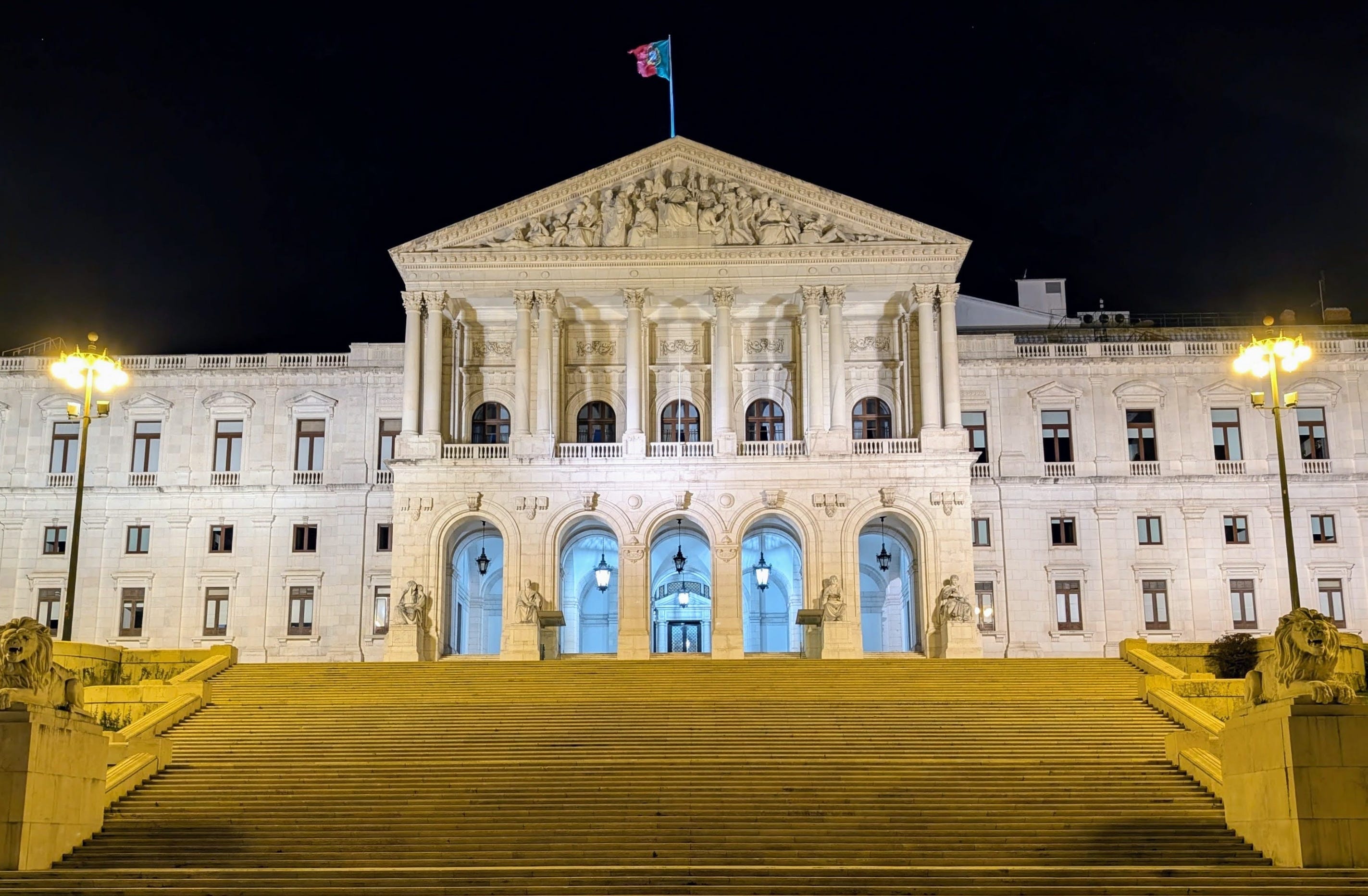
On Friday, Portugal's parliament voted to advance three bills that would dismantle some of Europe's most progressive gender identity protections, in a joint effort between the country's center-right governing coalition and its surging far-right opposition. Colelctively, the bills would ban gender-affirming care for transgender youth, require adults to obtain approval from a medical team before changing their name or gender marker on civil documents, and prohibit the discussion of "gender ideology" in schools for anyone under 18—a provision that mirrors the "don't say gay" laws sweeping American red states. If enacted, the legislation would revert the country to a 2011-era framework that treated being transgender as a disorder requiring intensive clinical diagnosis steps rather than an identity people could freely embrace. The bills still face several procedural steps before becoming law, but with a commanding parliamentary majority behind them, they appear well on their way.
The bills are sweeping in scope and echo efforts to target transgender people in the United States and, increasingly, internationally. One bill, from PSD, the center-right party that leads Portugal's governing coalition, would return name changes and gender marker changes to a 2011-era framework requiring adults to obtain a formal diagnosis of "gender incongruence" from a multidisciplinary clinical team including a physician and a psychologist—a process that requires navigating Portugal's limited number of specialized sexology programs and that activists fought for years to eliminate. Because the bill revokes 2018 protections in their entirety, it would also eliminate broad anti-discrimination protections based on gender expression, school nondiscrimination for trans students, social name protections for minors and nonbinary people, and sports.
Another bill, proposed by Chega, the country's far-right party, would ban all gender affirming care for trans youth, prohibit the discussion of "gender ideology" in schools for anyone under 18, and would return to legal language pathologizing transgender people. The Chega bill would also weaken anti-discrimination protections for transgender people in bathrooms, prisons and sports competitions, allowing them to be overridden on a case-by-case basis when "security, privacy, or physical integrity" of others is deemed at stake.
A third bill, from CDS-PP, the coalition's Christian conservative junior partner, would specifically ban puberty blockers and hormone therapy for transgender minors. LGBTQ+ organizations warned that the bills would also strip protections for trans youth who have already begun socially transitioning at school and in their communities.
All three bills passed first reading on a vote of 151 to 79. During the debate, members of parliament used incendiary language toward transgender people that appeared borrowed directly from the American far right. Paulo Núncio, representing CDS-PP, called gender-affirming care for minors "the greatest delusion of wokism against children in Portugal. “Chega MP Madalena Cordeiro declared that "a man is a man and a woman is a woman.” After the vote, Chega's parliamentary leader Pedro Pinto declared victory, telling reporters that "fortunately the right has united" and that "a man will always be a man and a woman will always be a woman."
"These initiatives represent a step backward for all trans and intersex people and an attack on the bodily integrity and individual autonomy of everyone," read a statement from more than 60 civil rights organizations published on ILGA Portugal's website ahead of the vote. On the day of the debate, demonstrators gathered in the rain outside the Assembleia da República in Lisbon, where organizers read a manifesto that linked the vote to the broader erosion of democratic rights.
Here are some excerpts from the manifesto:
Trans people did not appear yesterday. Nor did we emerge from a word—the word appeared to categorize and to constrain us. We existed before there were laws or parliaments. In many cultures, we have existed so universally and so diversely that no words were even needed to describe us. In others, we survived invisibility, violence, systematic erasure, and fetishizing visibility—without rights, without protection beyond empty slogans. But we are still here.
Because resistance, too, is inherited. Because memory, too, is a political act. Because every generation of trans people that survived left those who came after with one certainty: we existed before the boxes they try to lock us in
…
We are handed over as bargaining chips in an obvious handshake with the far right, just as immigrants have been. But make no mistake—this is not only about us.
It is about how rights can be traded away in the service of other partisan and structural interests.
This attack on our rights is only the beginning—the beginning of many others being revoked, such as marriage equality or the right to abortion.
We will not allow it.
In a joint statement, six of Europe's leading LGBTQ+ organizations—including ILGA-Europe, TGEU and OII Europe—warned that the bills represent "a serious attack on the rights, dignity, safety and bodily autonomy of trans and intersex people in Portugal," marking "a significant regression in a country that has, until now, been regarded as an important point of reference for legal protection in Europe." If adopted into law, the organizations said, Portugal would drop at least four places on the ILGA-Europe Rainbow Map, falling below Sweden, the Netherlands, Ireland and France.
The bills now head to committee, where they will be debated and could be amended before returning to the full parliament for a final vote. The three bills will need to be reconciled during that process, and the PSD bill—as the governing party's proposal—is likely to form the basis of any final legislation. If the bills pass, they would land on the desk of President António José Seguro, a center-left Socialist. Seguro has the power to veto legislation or refer it to the Constitutional Court. For now, the 2018 law protecting transgender people remains in full effect.
Shit. Also - they were on my might escape to list. That list is getting vanishingly small.
Portugal has long been recognized as a country that embraced equality, dignity, and human rights.
The rise of anti-trans legislation now being championed by far-right political forces represents a dangerous and deeply regressive departure from those values.
These bills are not about protecting anyone — they are about targeting transgender people and stripping LGBTQ+ communities of rights, safety, and recognition under the law.
They weaponize fear and misinformation to marginalize a vulnerable minority, turning human beings into political scapegoats for ideological gain.
Transgender people deserve the same freedoms, protections, and respect afforded to every citizen: the right to live openly, access healthcare, participate fully in society, and exist without government-sanctioned discrimination. Policies that single out LGBTQ+ people for exclusion undermine democracy itself by declaring that equality is conditional.
Portugal should be moving forward, strengthening inclusion and human rights protections — not importing the politics of division and exclusion spreading across parts of Europe and beyond.
History has shown repeatedly that when governments begin rolling back rights for one group, the foundation of freedom for everyone is weakened.
I stand in solidarity with Portugal’s LGBTQ+ community and all those resisting these discriminatory measures.
Equality is not negotiable. Human rights are not partisan. And dignity cannot be legislated away.