

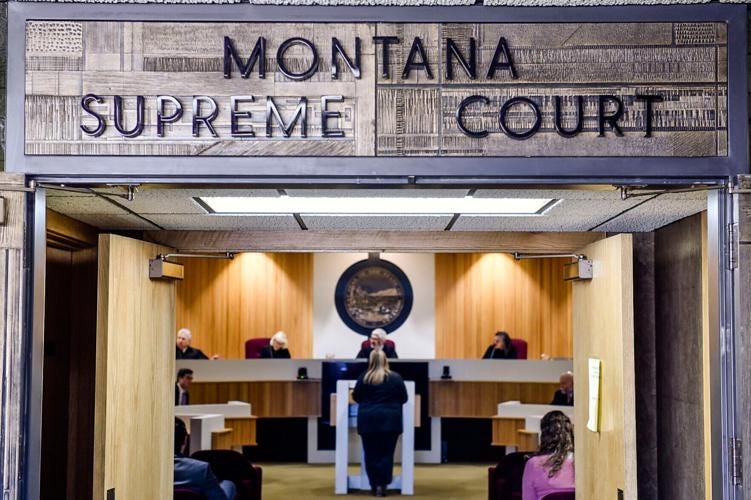
On Monday, the Montana Supreme Court issued a landmark 5-2 ruling declaring that "transgender discrimination is, by its very nature, sex discrimination," and that transgender people constitute a suspect class under the state's equal protection clause. The ruling in Kalarchik v. State of Montana blocks a definition-of-sex law and related state policies that stripped all legal recognition from transgender people and barred them from obtaining accurate birth certificates and driver's licenses. The decision rests on Montana's constitution, whose Equal Protection and Individual Dignity clause has been repeatedly interpreted to protect transgender people—and which the court made clear provides far greater protection than the federal constitution. Justices have now issued the clearest declaration ever that transgender people in the state will have enhanced protections of their rights, grounding the ruling in equal protection, sex discrimination, and privacy—principles with broad applicability in a state that has become a major battleground for anti-trans legislation and resistance to it.
The ruling stems from a challenge to three interlocking state policies: Senate Bill 458, a 2023 law that defined sex as strictly binary throughout the entire Montana Code; a 2022 rule from the Department of Public Health and Human Services that restricted birth certificates; and an unpublished 2024 Motor Vehicle Division policy that barred transgender people from updating their driver's licenses. Together, the policies eliminated all pathways for transgender Montanans to obtain accurate identification documents. SB 458 was particularly sweeping—it inserted a rigid binary definition of sex into Section 1-1-201 of the Montana Code Annotated, the state's general definitions statute, meaning the definition rippled through virtually every area of state law: insurance regulations, employment protections, drivers licenses, birth and death certificates, and equal pay provisions. As Montana state Rep. Zooey Zephyr described the law's impact, it impacts trans people “from the cradle to grave." In December 2024, Lewis and Clark County District Court Judge Mike Menahan blocked all three policies, finding that the plaintiffs had a "fundamental right to be free from discrimination on the basis of sex under the Montana Constitution" and that the state had failed to articulate any compelling interest in enforcing them.
Now, a 5-2 majority of the Montana Supreme Court has affirmed that ruling and gone further. Justice Laurie McKinnon, writing for the majority, declared: "Government issued identification documents are necessary to access public life. When they do not accurately reflect a person's sexual identity, the transgender Montanan is prevented, based on their sex, from obtaining the same attributes of public life that a cisgender Montanan may obtain. Hence, the inability of transgender Montanans to receive government-issued identification documents accurately reflecting their gender identity is fundamentally about the nature of sex and suspect class discrimination under Article II, Section 4—a clause that enshrines individual dignity, equal protection, and nondiscrimination. Transgender discrimination is, by its very nature, sex discrimination." (emphasis added)
The court also went a step further. The Montana court separately declared that transgender people constitute a suspect class under the state's equal protection clause. In legal terms, a suspect class is a group that has historically faced such severe discrimination that any law targeting them must meet the highest level of judicial scrutiny to survive—the same standard applied to laws that discriminate on the basis of race. The Montana court stated: "Being transgender is also a suspect class under the Equal Protection Clause of Article II, Section 4—'no person shall be denied equal protection of the law.' The central premise of our state's equal protection guarantee 'is that persons similarly situated with respect to a legitimate governmental purpose of the law must receive like treatment.'" The practical effect is sweeping: any Montana law that singles out transgender people will now face strict scrutiny, meaning the state must prove the law serves a compelling interest and is narrowly tailored to achieve it—a standard that laws almost never survive.
The court's reasoning following this determination is straightforward. Under Montana's policies, if a cisgender woman's birth certificate incorrectly lists her as male, she can have it corrected to say female. But a transgender woman whose birth certificate also lists her as male—and who also lives, presents, and is perceived as female—is denied that same correction. Both women want the same document: one that says "F." One gets it; the other does not. The only difference is the sex they were assigned at birth. That, the court held, is sex discrimination—because the state "tolerates certain traits in one sex that it condemns in another." The state argued its policies apply equally to everyone, but the court dismissed this, finding that "the State's position ignores that only transgender persons are discriminated against when they are not allowed to have identification documents that match their gender identity." Because sex is explicitly protected under Montana's constitution, that discrimination triggers strict scrutiny.
The ruling was not universally agreed upon. Justice Baker, though part of the court’s left-leaning majority, issued a separate concurrence that took a narrower path, grounding her reasoning in Montana’s Individual Dignity clause rather than the majority’s broader holding that transgender people are a suspect class. Baker wrote that “when a person is forced to carry and display a government identification document that does not match who they look like or how they present themselves, this dishonors their dignity.” However, she appeared open to leaving portions of the definition-of-sex law intact, writing that “whether that requires invalidating SB 458 in its entirety must await determination on the merits.”
The two dissenters were far more hostile toward transgender people. Justice Jim Rice repeatedly referred to the plaintiffs—both transgender women—using male pronouns and the phrase “biological male” throughout his dissent, and dismissed the term “cisgender” as “not only inaccurate but potentially offensive.” He devoted multiple pages to a hypothetical about a person who identifies as “trans-aged,” sourcing the concept from Evie Magazine—an alt-right publication that the Southern Poverty Law Center has identified as promoting “male supremacist politics of the hard right” and that Media Bias/Fact Check rates as publishing conspiracy theories and pseudoscience—and from a blog post on Care-Net.org, an evangelical anti-abortion crisis pregnancy center network. Chief Justice Cory Swanson, joining Rice’s dissent in full and writing his own, accused the majority of issuing “a political decision dressed up in constitutional garb” and predicted that the ruling “will not endure, nor should it.”
The ruling is monumental for transgender Montanans. Because the decision rests entirely on the Montana Constitution, it is insulated from the U.S. Supreme Court. Under the principle of adequate and independent state grounds, the federal Supreme Court cannot review a state court's interpretation of its own constitution, so long as that constitution provides more protection than the federal one. Montana's does—and it is not close. Adopted in 1972, Montana's constitution is widely considered one of the most progressive in the nation. Its Article II, Section 4, titled "Individual Dignity," contains three separate protections with no federal equivalent: a dignity clause declaring that "the dignity of the human being is inviolable," an equal protection clause, and a standalone non-discrimination clause that explicitly lists sex as a protected category—something the U.S. Constitution does not do. Montana's constitution also enshrines a direct right to privacy that the state supreme court has already used to strike down the state's ban on gender-affirming care for trans youth.
The majority in this case made the independence of its analysis explicit, writing: "Montana case law interpreting the Individual Dignity provisions directs our analysis, not federal precedent." The dissent cited Trump v. Orr and Skrmetti—both hostile federal rulings—but the majority rejected them outright. What this means in practice is that Montana's transgender residents now have a constitutional shield completely independent of the Supreme Court of the United State’s decisions.
The case now returns to District Court for a full trial on the merits. Meanwhile, Gov. Gianforte signed SB 437—a law nearly identical to the one just blocked—on March 24, just three weeks before this ruling. Attorney Rylee Sommers-Flanagan of Upper Seven Law has already filed a request to add SB 437 to the existing lawsuit, telling the Montana Free Press, "There is not a substantive difference between the laws." With the Montana Supreme Court now on record that transgender discrimination is sex discrimination and that transgender people are a suspect class, any future law targeting them in the state will face the highest level of constitutional scrutiny, and should help overturn all future laws targeting trans people should the court’s makeup remain similar.
Disclaimer: The author of this piece is lovingly married to Representative Zephyr of Montana.
Such good news when there's so much bad news on a regular basis. Thank you for all of your reporting!!!
WOO HOO!!!
Hooray for Montana!
Thank you to the two trans women and their lawyers who brought this suit forward.