

Brazilian President Luiz Inácio Lula da Silva has a lot to celebrate after winning a historic fourth term against Flávio Bolsonaro, the far-right son of former President Jair Bolsonaro, whose supporters stormed government buildings in January 2023 in protest of Lula’s earlier victory. The elder Bolsonaro was sentenced to 27 years in prison for plotting a coup—he is now serving that sentence under house arrest—and is barred from running for office until 2060.
Lula’s win Sunday marks a break from the far-right tilt of other recent elections in the region. It means Donald Trump’s influence via the Bolsonaros is considerably defanged. And it means Brazil’s highest office won’t become yet another blunt object with which to antagonize transgender people.
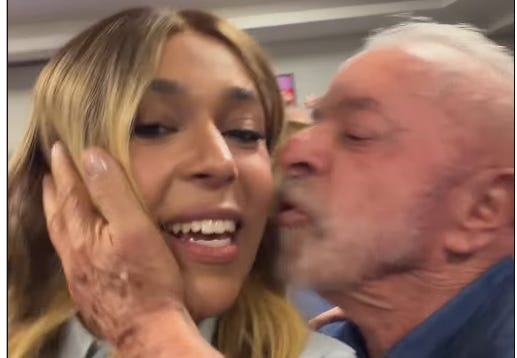
Erika Hilton, a Brazilian lawmaker who is also trans, was standing right by Lula’s side on the night of his victory. In a now-viral video she posted to Instagram, the two can be seen in a crowd of cheering people as Brazil’s president kisses her on the cheek and Hilton shouts (roughly translated into English), “That’s my president! I never doubted you.”
It would be remiss not to emphasize that the gesture is much more common between friends in Latin American cultures than it is in the United States. But it is still a striking visual: Perhaps without trying, Lula sent a powerful message. He embraced Hilton while many politicians, especially in the U.S. and including Democrats, refuse to touch trans issues (let alone trans people).
Hilton’s own star power cannot be overstated, either. She was reelected earlier this month to represent the state of São Paulo with more than 1.5 million votes, the most any woman has ever received in a race for the chamber. In 2023, she oversaw the united front of lawmakers dedicated to stopping a same-sex civil unions ban. Her advocacy crosses borders, too. Last year, she took on the Trump regime after officials ignored her Brazilian ID to declare her “male” on a U.S. travel visa.
“This election marked a turning point for trans rights in Brazil and Latin America,” said Victória Dandara, a lawyer and trans rights scholar originally from Brazil. She’s also a policy and legal fellow at the Council for Global Equality.
For one thing, she lauded Lula for defeating Bolsonaro’s proposed form of government entrenched with “anti-gender” policies, including an anti-trans athlete ban.
When Lula was down in the first round, he didn’t try to court voters by appealing to the anti-trans electorate. Instead, his campaign won by focusing on mobilizing voters who had otherwise abstained. He signed a number of eleventh-hour economic reform bills. Finally, young people helped carry him over the finish line.
“It has a symbolic component,” Dandara added over email. She called it a rejection of “the authoritarian fascist option aligned with Trump and the international trend taking over the region (such as De La Espriella’s government in Colombia, Fujimori’s in Peru, Kast’s in Chile, and Milei’s in Argentina).”
“Brazil taught the world a lesson in collective organizing and democratic resiliency,” she said.
The New Republic’s Perry Bacon, a seasoned political correspondent, went a step further. He called Lula’s victory “something of a roadmap for those trying to fight authoritarians around the world.”
Electing another Bolsonaro, Bacon writes, would have been “essentially an exoneration of his coup attempt”—the elder Bolsonaro refused to concede his 2022 loss, and his allies attacked halls of governance in an attempt to stop the transfer of power.
According to Brazil’s National Association of Travestis and Transsexuals (ANTRA), there were other major landmarks for the trans community in this election, too. The group counted 116 trans and “travesti” candidates running for office across Brazil—the most since ANTRA began tracking candidacies in 2014, and up from 79 in 2022.
Lula’s victory makes him the first Brazilian president to be elected to four terms, and the first candidate since Brazil’s return to democracy in 1985 to win the presidency after finishing second in the first round.
As for the video of Hilton—Dandara saw that, too.
“It’s fair to say that the whole LGBTQI+ community from Brazil, and maybe Latin America, felt kissed and seen in that gesture,” she said.

Young people made the difference in Hungary also. Not everyone under 30 (or whatever the magic number is today 😏) is progressive, but the majority are. Many of them have to be motivated to vote. 80-year-old Lulu figured out that he needed staffers and supporters to get on the platforms that would reach those voters. Hearty congratulations!
Brazil Has a Lesson for America!
Lula of Brazil deserves recognition, along with the people of Brazil who choose to embrace the transgender community rather than fear, reject, or discriminate against them. A society should be judged by how it treats its people, especially those who too often face prejudice and exclusion.
Our politicians here in the United States should learn from Brazil. Instead of using transgender people as political punching bags to score points, they should be standing up for their dignity, their rights, and their ability to live freely without fear.
Transgender people are not the enemy. Discrimination and intolerance are the problems we should be confronting.It is time for our politicians to stop exploiting people's differences for political gain and start leading with compassion, understanding, and respect.
America should be setting an example for the world—not looking to other countries to learn lessons about treating our fellow human beings with dignity.