

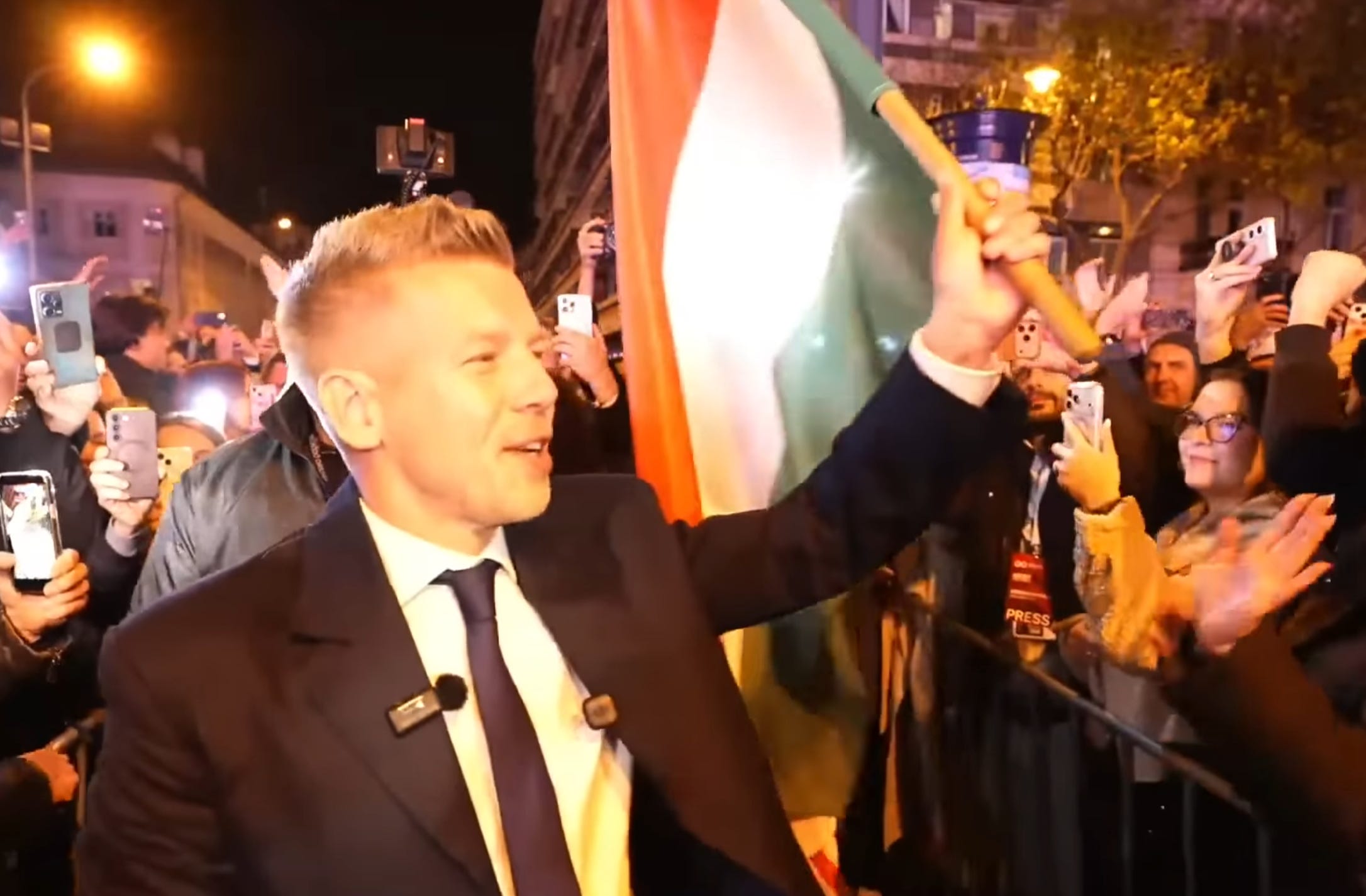
On Sunday, Hungarians flocked to the polls in record numbers to oust Prime Minister Viktor Orbán from office in a historic election, delivering a stunning defeat to a fiercely anti-LGBTQ+ regime that enacted some of the harshest laws against its LGBTQ+ population in Europe and was broadly viewed as autocratic. The defeat came despite Vice President JD Vance traveling to Budapest to decry trans people just days before the election to campaign for Orbán, and President Trump endorsing him on Truth Social. Instead, Péter Magyar's Tisza Party won 138 of 199 parliamentary seats in a landslide, securing a two-thirds supermajority with nearly 80% turnout, the highest in Hungary's recent history. The victory brought hope to many across the country, but especially to LGBTQ+ Hungarians, who saw it as a signal that the tide could be reversed on years of draconian laws targeting their community. That hope was advanced on Sunday night, when in front of tens of thousands of supporters gathered along the Danube River in Budapest, Magyar directly addressed the previous regime's treatment of LGBTQ+ people, declaring that he would pursue a government where "no one is persecuted because they love differently, or love in a different way than the majority."
"I long waited for this. I was 12 when this bullshit started. Now I feel so hopeful for the future. I know this is just the starting line. But finally we could step on the track," wrote Alice Grey, a transgender Hungarian woman, on Bluesky. Grey said Magyar's victory speech left her stunned—not because of a sweeping policy promise, but because of what it didn't contain: hatred. "He said that he will serve every Hungarian, listed some starting each with 'doesn't matter x' and said 'doesn't matter how they love,'" she wrote. "I was so shocked. In Hungary, a president acknowledged any LGBTQ+ related thing without hatred. This is so new for us." She added that the speech gave her hope that she might "finally get out of our trans care hell and finally properly begin my transition journey."
Magyar ran a campaign that some LGBTQ+ Hungarians criticized as too cautious, choosing to avoid LGBTQ+ issues almost entirely. Háttér Society, Hungary's leading LGBTQ+ rights organization, noted that "neither Magyar, nor his party have reached out to the organization," and their election guide stated bluntly that "the party's election program does not address LGBTQ+ issues." In a country where the government banned legal gender recognition for trans people, criminalized Pride marches with up to a year in prison for organizers, and is currently prosecuting Budapest's mayor Gergely Karácsony for allowing the 2025 Pride march to proceed, even Magyar's silence was a departure from the norm. But he did offer signals. He called the Pride ban a distraction from the suffering of ordinary Hungarians and said a Tisza government would protect the right of assembly. When asked about same-sex adoption, he said that in his personal opinion, a child is better off with a same-sex couple than in the child protection system.
However, upon winning the election, Magyar came out more fiercely. Speaking to tens of thousands along the Danube, he promised a country "where no one is stigmatized because they think differently than the majority. No one is stigmatized if they love someone else, and love differently than the majority." He decried the division of Hungarians against one another, declaring, "it is not allowed to differentiate between Hungarian and Hungarian, to divide, because that is a sin." He vowed to liberate the judiciary, and promised that those responsible for the previous regime's abuses would face consequences. "From now on, this will not be a country without consequences," he said. "Those who robbed the country must take responsibility. Those who incited hatred between Hungarian and Hungarian, they must take responsibility."
You can view the full speech here (Hungarian):
LGBTQ+ organizations in Hungary encouraged their communities to vote, even as they expressed frustration with the lack of specific commitments. On the eve of the election, Háttér Society posted a message to its followers encouraging them to vote. The post linked to the organization's election guide, which documented each party's stance on LGBTQ+ issues. The guide noted that while Tisza's official platform did not address LGBTQ+ issues, Magyar had repeatedly spoken of building a country where "it does not matter whom they love," had pledged to protect the right of assembly, and had personally stated that a child is better off with a same-sex couple than in the child protection system. By contrast, the guide documented Orbán's Fidesz party's extensive record of anti-LGBTQ+ legislation, and noted that the far-right Mi Hazánk party openly characterized LGBTQ+ people as "deviant propaganda" and a "cultural Marxist, anti-white, anti-Christian, anti-family worldview."
American anti-LGBTQ+ and far-right Christian nationalist forces have long drawn inspiration from and cooperated with Orbán’s autocratic government. Since 2022, CPAC—the Conservative Political Action Conference, a major gathering of the American right—has held annual satellite events in Budapest, where Orbán delivered keynotes declaring that “the woke movement and gender ideology are exactly what Communism and Marxism used to be.” The Orbán-linked Danube Institute hosted American conservative researchers to study Hungary’s policies, and its executive director told a Hungarian publication that Florida Gov. Ron DeSantis’s “Don’t Say Gay” law—which banned instruction on gender identity and sexual orientation in schools—was inspired by the Orbán government. DeSantis’s own press secretary confirmed the connection, stating, “We were watching the Hungarians.” Hungary’s 2021 anti-LGBTQ+ law, which banned the “promotion” of homosexuality to minors, preceded Florida’s law by nine months. Hungary’s 2020 ban on legal gender recognition for trans people likewise predated and may have influenced the wave of similar efforts in the United States happening now.
In the leadup to Sunday’s election, Vice President JD Vance traveled to Budapest to campaign for Orbán at a rally, telling the crowd, “We have got to get Viktor Orbán re-elected. Specifically, he said, “Across the left, there is a band of radicals… They reject mothers and motherhood, fathers and fatherhood in the name of liberation. They condemn children to mutilization and sterilization in the name of gender care, and they practice institutional murder in the name of quote end of life planning." President Trump endorsed him on Truth Social. Orbán lost anyway—and the playbook he exported to the American right lost with him.
See Vance’s speech decrying trans people in Budapest:
Hungary has been the site of some of the fiercest anti-LGBTQ+ laws in Europe in recent years, ranking among the worst in ILGA-Europe's most recent Rainbow Map. In 2020, Orbán's government banned legal gender recognition for trans and intersex people entirely, making it impossible to change legal documents. That same year, a constitutional amendment declared that "the mother is a woman, the father is a man" and effectively banned same-sex adoption. In 2021, parliament passed a sweeping law banning the "promotion" of homosexuality or gender change to anyone under 18 in schools, media, and advertising. In 2023, the Constitutional Court closed the door on trans recognition permanently, ruling that anyone who hadn't applied before the 2020 ban was locked out forever. And in March 2025, parliament criminalized Pride marches, with up to a year in prison for organizers and police facial recognition authorized to identify attendees. Despite the ban, up to 200,000 people attended Budapest Pride last June in one of the largest anti-government demonstrations in years.
It remains uncertain which, if any, of these laws Magyar's government will overturn. His campaign stayed silent on specifics. But with a two-thirds supermajority, Magyar has the constitutional power to reverse every anti-LGBTQ+ law Orbán enacted—from the trans recognition ban to the Pride criminalization to the constitutional amendments themselves. What is already clear is that the anti-LGBTQ+ panic that fueled Orbán's autocratic regime—and that was exported to state legislatures across the United States—has been repudiated by the Hungarian people themselves in this historic election. LGBTQ+ people will rest slightly easier knowing that regime is gone.
I will have trouble forgiving myself if I feel later I have jinxed things to say it -- the end of Orbanism is a part of a trend. To the mid-terms!
Thank you, Erin.
If the Hungarians can dump Orbán and his parliament after 16 years, we BETTER be able to defeat Trump’s Congress after two! We Trans people saw what was coming because Trump came after us first. In essence we along with people of color have been the canaries in the coal mine. Now go out and VOTE, like our Hungarian trans brothers and sisters.